
Millions of Views on a Small Budget: Mudplugz’s Product Launch Strategy

Updated: 6 days ago
What do you do when your product solves a real problem, but your advertising isn’t generating the growth you need? For Kevin Cost, founder of Mudplugz, the breakthrough came from an influencer demonstration that helped turn an unfamiliar product into something homeowners around the world wanted to try.
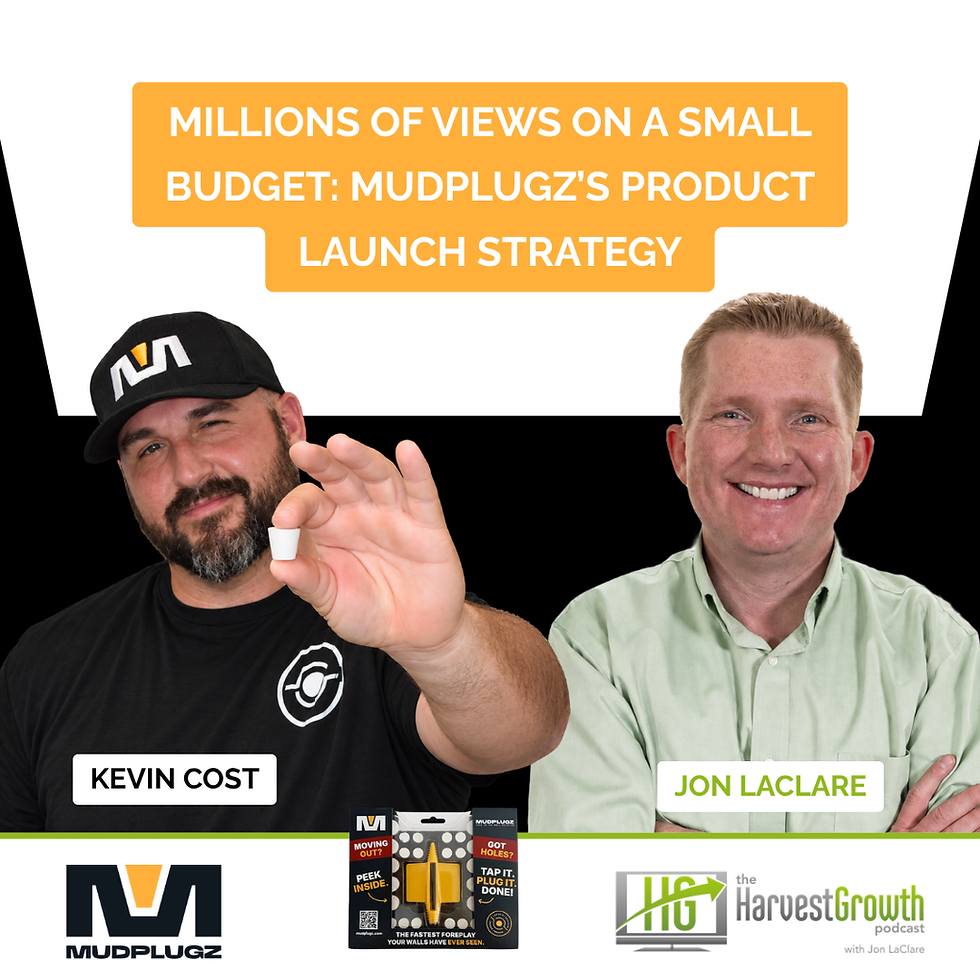
In this episode of The Harvest Growth Podcast, host Jon LaClare sits down with Kevin to explore how a Christmas Eve idea became an innovative drywall repair product and a growing business. A finish carpenter by trade, Kevin taught himself CAD and 3D printing, turned his kitchen into a product development lab, and brought Mudplugz from concept to first sale in roughly one year.
When his early Meta and Google advertising efforts fell short, Kevin found traction through creators who understood the frustration his product solved. One launch video generated approximately 40,000 views in its first 30 minutes, eventually reached millions, and brought in orders from around the world. Kevin shares why authentic product demonstrations, trusted creators, and personal relationships became central to his influencer marketing approach.
Kevin also opens up about nine years in recovery from alcoholism and how he uses his businesses to create opportunities for others rebuilding their lives. His story offers practical lessons in product development, marketing on a limited budget, and building a business with purpose.
In today’s episode of the Harvest Growth Podcast, we’ll cover:
How Kevin developed a new consumer product without prior experience in CAD or 3D printing.
What made an influencer launch video generate millions of views and international orders.
Why showing a product solving a familiar frustration can help turn attention into sales.
How genuine creator relationships helped Mudplugz gain exposure on a limited marketing budget.
What Jon’s experience working with Billy Mays reveals about persuasive product demonstrations.
How Kevin creates work opportunities for people in recovery while growing his business.
The spending lessons Kevin carried from his carpentry business into his product launch.
You can listen to the full interview wherever you listen to your podcasts.
Or, click to watch the full video interview here!
Visit Mudplugz.com to learn more about Kevin’s drywall repair solution, or search for Mudplugz on Amazon. Explore the brand’s social media to see the product demonstrations discussed in this episode.
Ready to launch your product or grow your brand? Visit HarvestGrowth.com to book a free consultation and learn about the Perfect Launch Blueprint, a process designed to clarify your audience, messaging, offer, and marketing strategy before you invest in media.
Visit HarvestGrowth.com to book a free consultation and learn how our team has helped generate over $2 billion in product sales.
Read the full interview transcript: [00:00:00] Jon LaClare: Today's interview is a great reminder to pay attention when inspiration strikes. My guest had an idea come to him out of nowhere while watching a movie with his family on Christmas Eve. He followed that inspiration and turned it into a groundbreaking new product and a growing business. We talk about how he developed the product from scratch, and how he found creative ways to generate sales and millions of views with a very limited marketing budget.
But what I enjoyed most about this interview is the person behind the [00:00:30] business. My guest is a genuine giver, who is nine years into his own recovery from alcoholism, and now uses his business to help others in recovery get back on their feet. It's a great story about inspiration, perseverance, giving back, and building a business with purpose.
I think you're gonna love this interview.
[00:00:50] Announcer: Harvest the growth potential of your product or service as we share stories and strategies that'll make your competitors nervous. Now, here's the host of the Harvest [00:01:00] Growth podcast, Jon LaClare.
[00:01:02] Jon LaClare: Over the past 20 years, our team has helped launch and grow hundreds of consumer products, generating more than $2 billion in revenue for our clients.
On this show, we break down what actually works in product marketing. These are real stories, real strategies, and lessons that you can put to work in your business right away. Whether you're getting ready to launch or you're looking to scale what's already working, you're in the right place. All right.
Let's jump into today's interview. Before we get too far into the details, I wanna first welcome [00:01:30] our guest to the show today, Kevin Cost. Thank you for joining us today.
[00:01:33] Kevin Cost: Hey, how you doing? Thanks for having me.
[00:01:36] Jon LaClare: Absolutely. So by way of introduction, Kevin Cost is the founder of Mud Plugs. It's M-U-D-P-L-U-G-Z at the end.
mudplugs.com. You can find it on Amazon as well. We're gonna dive into the story, but before we do, can you just give us a quick description, Kevin, what are Mud Plugs?
[00:01:54] Kevin Cost: So the easy way to put it, they are drywall repair plugs, right? So [00:02:00] you, uh, take out your drywall anchors. They're not for big holes from your fists in the wall.
They're not from, you know, stuff like that. They're made for drywall anchors, you know, the holes that are too big to replace drywall, but they're too small to just fill with patch. You take the little tool, you take the anchor out, you take the little tool, it preps the hole, take one of these plugs, throw it in water, wait 30 seconds or so, put it in, use this little wing as like the putty knife, scrape it, done.
[00:02:30] Doesn't shrink. You can sand and paint it within an hour
[00:02:34] Jon LaClare: And it is so easy. You were n- you were nice enough to send me some, and I've been using them. Unfortunately, we have lots of holes in our house. We've been in our house for 20 years, so as you can imagine, so I got that home, I was like, "I'm gonna repair a couple of things we haven't done for a while, and just to try it out."
It is incredibly easy to use, and the appearance is so much better than spackle. You know, like kind of the normal way of, of repairing these, or traditional way, let's say, of, of repairing these holes. If you try this once, you'll never go back to, to old-fashioned spackle again. [00:03:00] Before we get... We'll get back to the product.
I, I wanna, uh, uh, the details of how it works, all that kind of stuff. But let's get into your origin story, 'cause I think it's really interesting. Let's... If you can take us back in your story. It was Christmas Eve many years ago when this idea first came to you while you were watching a movie on TV with your daughter.
Can you tell us that story?
[00:03:18] Kevin Cost: So every, uh, tradition is Christmas Eve, we watch Elf, right? In my opinion, probably one of the greatest Christmas movies of all time. Um, as soon as the movie ended, now remember, I wasn't doing any drywall work, I wasn't [00:03:30] thinking about work. I mean, honestly, it's Christmas Eve, I'm definitely not thinking about work, right?
So, um, and once the movie was over and the credits were rolling, I had this idea. It hit me, like, the best example I can give you is when they talk about being hit, like, by a freight train. Like, it came out of nowhere and just smacked me right in the brain, right? So my first instinct was, "Let me Google it.
Let me see if this thing even exists." It has to, right? So I Google it, I type it in as drywall plug [00:04:00] And it just, it didn't exist. And I went-- So I started looking at different wording and stuff. I was like, "There's gotta be something." And then by trade, since I was 19, I'm a finished carpenter. So we use wood plugs or dowels to fill holes all the time.
So I'm not, uh, not a stranger to the idea, right? On at least the wood standpoint. So it didn't exist, and I, uh, text my business partner. I'm like: Dude, I have a billion-dollar [00:04:30] idea. I didn't know what it looked like. I didn't know how it worked. I didn't know there was gonna be a tool. I didn't know anything about it.
I just knew that there's a drywall plug, and when it comes to, like, f-filling anchor holes, why not? And remember, I'm not a drywall guy either. I'm not a painter. I-- To be honest with you, the thing I hate more than anything about my job is having to touch drywall and deal with drywall, just from hanging doors or baseboards or whatever else.
Excuse me. [00:05:00] And, uh, so he's like, "Let's, let's work on it." So I literally turned my kitchen into a lab because anyper- anybody that's dealt with, uh, drywall mud knows that you're-- once it dries, it does not come back, right? And who, who really tries to make it come back? That's where kinda spackle comes in. Or if you think about it, once that s- tub of spackle dries out, which it has for everybody, nobody's trying to bring it back to life.
They're throwing it away, and they're buying another one for even, uh, three, four holes. So I turn my [00:05:30] kitchen into a lab and just start throwing random things in it. All safe things, by the way. Let me put that out there. Nothing, uh, you know, toxic or whatever. And I learn how to use a, uh, a 3D printer and, like, learn how to use CAD.
So I taught myself how to do that to design something which I didn't know it was this. I just... I don't know, man. I, I like to think it's a divine intervention that led me step by step through this whole process that got here, [00:06:00] and that's really where my credit goes. And, uh Hey, if you would've asked me back then that it would've turned out to be as amazing as it is, I would've said, "Eh, you know, I don't, I don't think so, but I mean, it sounds cool."
But it's turned into like something I didn't even think was possible. So but that's really out of nowhere, man. It's-- And it was... It took about four or five months until I could get a prototype to the, the patent attorney. And once he saw it, he sat like five seconds with this [00:06:30] like blank stare on his face, and he goes, "This, this is genius."
And I hate using words like that 'cause that's not my style or whatever. He goes, "This is genius." He goes, "We're gonna have fun with this one." So we did everything to protect it, patent, trademark, all of the above, and went into figuring out manufacturing. So probably from conception to sale was about a year and two months.
No, a year and like two weeks [00:07:00] from that process. So it's, and it's definitely been a dream
[00:07:04] Jon LaClare: Which is actually pretty fast. That's a, that's a pretty quick process, and, uh, you know, hats off to you for following inspiration. Whatever you wanna call it, right? I, I'm a big believer in that. When you get these moments of inspiration, especially when you're running a business or you're about to, right back in...
If, if you rewind, follow those, right? Those are clear steps of direction, and really, it's where the, the i- best ideas come from. It's often when we're distracted doing something else. You're enjoying your [00:07:30] time with your daughter, right, when you're with family. That's when these moments of inspiration can come and do something with them.
Not all of them are gonna be right on, right? But at least walk down that path to check them out and, and, and see what's next with it, and luckily you did that. Luckily you didn't ignore it. You kept going and have built a, a very successful business since that point forward, for sure. I, I like you pu- told me part of this story, uh, before that as you went on Google that night and tried to look for some of these ideas, you saved some of the screenshots.
I love that. It's kinda like, I think back to, you know, when I started this [00:08:00] business, our very first check was like 1,200 bucks I think or whatever. I've got a, a copy of it framed on my wall as, you know, like you put a dollar bill in or whatever. It was where it all started, right, 20 years ago. Um, and you know, kind of luckily grown a lot since that point forward.
But I love that you kept those screenshots, part of that research. Uh, you know, what made you think to do that, I guess at the time?
[00:08:20] Kevin Cost: To keep the screenshots? Yes. Yeah. I didn't, I didn't at the time. I just, I looked back on them. Just in te- text message thread that's probably, [00:08:30] you know how long it was. Until you replace a phone, your text message thread goes, can go years. And probably about- Yeah. Right ... I wanna say seven or eight months, I obviously knew what the date was. So I was like, "Let's let- let's go back.
Let me like reflect on this for a second. Like here's where we're at now. Let me go back and see like what, what did I say? What did we talk about?" And I look at it and I'm like, it was surreal. It was genuinely just like, wow, I can't believe that this has turned into this and so far [00:09:00] has gotten here. Which listen, we've got a long way to go.
But- It's- it still blows my mind, just honestly. So
[00:09:09] Jon LaClare: That's awesome. And what... Yeah, it's a cool thing to look back to and have that, that memory in your phone as screenshots to be able to look back to the very beginning of it. You know, you mentioned how you sat down with your patent attorney, and he was blown away by the idea as well, and I'm sure you've shared it with other people.
But there still is a point when you really realize this is gonna be big, right? It's going to work, right? Hearing positive [00:09:30] comments from people is one thing, but what was the big turning point in your business that you really realized, "Man, this... I've got something here. I've, I've created a business and it's working"?
[00:09:42] Kevin Cost: Let me see. I mean, a lot of the feedback just from the marketing company that we hired initially that helped with the logo, the branding, the brand voice, and all of that. I wanna say that, that where it really, really, like, hit home is we did a, um, a collaboration. I [00:10:00] guess we, um, hired a, um, an influencer or a couple of guys, these influencers, to do really our big launch video.
And, you know, and listen, we didn't have, like, that big... And we still don't have that big influencer money. Like, the people that put everything out there, thank God they just love the product or they love the journey of the story, so they do it for the sake of helping us. And I think a lot of them, like, they see the product and they go, "Well, I can make this go viral."
So, like, we have [00:10:30] that kind of backing with it. But these guys, they did their video, and they did it at, like, such a, uh, a fraction of the cost. When they launched it, it, it went crazy, crazy viral. Like, I... And they collaborated with us on Instagram, so I'm watching all the analytics. I wanna say within, like- 30 minutes, this thing had like 40,000 views.
I was getting tons of followers. I was getting orders from all over the world. When I tell you, people were ordering from [00:11:00] Australia and paying more for shipping than the kit cost. Canada, Australia, the UK, Singapore, Israel. I didn't know there was drywall in half these places. You know what I mean? So-- And the feedback is really everything.
We've had some instances where, you know, the tool, it's strong, it's rigid, but, you know, you put enough force into it, it, it is plastic. You know what I mean? If you, if you go and you just try to two-hand turn that thing, we've had some of the little [00:11:30] heads break off, you know. It doesn't happen often, but, um, the feedback is incredible.
Right now, our ratings on Amazon are, you know, four point six stars, you know, organically. So-- And granted, one of those broken ones is on there, and it's not helping our cause. But listen, that's out of my control at this point. We have reformulated the, the tool itself with a different polymer plastic that can't break.
But I still got [00:12:00] about ten thousand more to burn through before I start making that one, you know. So just the feedback has been incredible. Um, and I think just the, the whole thought behind... Like it works, right? It's like some people, you get plenty of people online that call it a novelty or, um, landlord special or there's just everybody has something to say online.
But, uh, it's more good feedback than not
[00:12:28] Jon LaClare: Absolutely. [00:12:30] I wanna dive a little deeper on the influencer topic, 'cause y- as you mentioned to me previously, you started with Meta and Google and other more traditional advertising approaches, and they weren't working well enough, right? They weren't helping the business to take off.
And, you know, we've launched hundreds of products over the last 20 years, and it's hard. Launching something brand new, there's a science behind it, and there's, you know, every product needs a, a nuance, right? There's something different about it that's going to change the type of marketing you do, the marketing channel, you do the messaging, et cetera.
And, you [00:13:00] know, we've gotten those channels to work, but it's hard. It's not-- It's certainly not easy, not the normal way. If you just think you're gonna put something on Meta and it's gonna, you know, with a pretty good video, and it's gonna work, there's more to it to really make it work. So I love that you pivoted early to figure out this influencer approach, and it's really continued to help your business grow from that point forward.
Before we get to other influencers, what do you think was it about that initial video that generated eventually millions of views and drove so many sales for you? What, you know, what was it in that video that really [00:13:30] caught people's attention, do you think?
[00:13:31] Kevin Cost: Well, I think the guys that did it, um, which was Refresh Home Improvements, these, uh, two brothers out of Canada, um, I wanna say that just the way they did it and the style they did it just made it look very clean, brand new.
'Cause they do like, like, a lot of their channel is different ways of patching drywall. And they said that they'll always, whatever comes out, we're gonna show you what it is, and that was part of it. And I think that's where they were willing to do it for the [00:14:00] discounted price because they knew when they presented it what it would do.
You know, so I think they wanted to kind of be a part of the launch. And, like, honestly, that video started a movement, in my opinion. Um, and I just think, I think that when it comes to repairing anchor holes, if you're a homeowner, a DIYer, I-- unless you're somebody that's rich that has a guy to do it, let's face it, we've all done it.
We've all bought spackle. We've all done this or done [00:14:30] that. And then, listen, I'm even a tradesman, but don't think I'm going to buy a bag of five-minute mud and mixing my own little concoction. I'll buy spackle like the rest of us. Um, it's a nightmare. It, it really is. It's-- And it's the only thing that we've ever really had in trying to repair those types of holes.
So I think what the way they launched it, I think resonated with people when they started seeing it and be like, "Ugh, I remember the last time I had to, you know, fill an anchor hole. It was a [00:15:00] disaster." For one thing, a hole that size turned into a mess that big for each one, and I think a lot of people can relate to that.
So when they did their video and pretty much showed And like when I go back to the whole thing of like, how is this not a thing? And if I can tell you how many times I've heard the word, "Why didn't I think of this? How is this-- how does this not exist?" I don't know. But I just know, I think it hits people at, I don't know if you wanna say emotional part of it, but the annoyance [00:15:30] of the process.
So you're telling me I can go into an apartment and I've got 20 holes now, and I can be done in 20 minutes, done and over with, and like get on with my life? I, I'm game for that. So at least I'm curious enough to try it out because most people have just anchors lingering in their walls because even if they move a picture or whatever else, that anchor looks a lot better than the hole there.
So they just leave the anchor in. So, you know. [00:16:00]
[00:16:00] Jon LaClare: And you, and you can... So I wanna clarify or have you clarify really, 'cause spackle's relatively easy to use, right? You can go to Home Depot, spla-splash some stuff on there and be done. But mud plugs is better. But I'd love you to clarify specifically for... You've kind of alluded to it in a couple ways, but how is it b-better, s-specifically better than, than the old-fashioned way of doing it?
[00:16:23] Kevin Cost: Sure. So spackle is great for what spackle does, right? But it's time-consuming, right? So you sit there and you [00:16:30] just, you pack the hole and depending on the size, you know, mud plugs we have half inch, five-eighths and three-quarters covers all of your different anchor sizes. Now go fill a three-quarter inch hole, right?
You're gonna put mud in, you're gonna put mud in. It kind of like spits itself back out. You keep putting it in, and the only way to get it to a point where you can walk away from it is to make it so thick that it's gonna take probably 12 hours to dry. You know, you can't just... Now, if you pack it in and wipe it out, you're still waiting several hours for it to dry [00:17:00] and it shrinks like a lot, right?
So now you're sanding, you're reapplying, and then possibly going into the third step aspect of things. With the plugs, you literally throw them in water and it doesn't matter, 30 seconds, 30 minutes, they don't evaporate because it's too long. You use a little tool, so you spend 15 seconds on that. You put it in, you scrape it, scrape it flush.
You can leave it a little proud if you want a better finish and just sand it off in an hour. But it's meant to dry fast and they don't shrink. The idea [00:17:30] is that they dry fast, they don't shrink. So it's really, it's-- I'm not gonna say it's instant, but you can do it and be done with it and move on. You know, spackle, it just, it's, it's time-consuming.
And let's face it, in a world of Amazon and cell phones, nobody wants to wait for anything anymore. So why wait for spackle?
[00:17:51] Jon LaClare: Yeah, you're right. And y- you think about, you talked about putting some in and having to put more in. I mean, think about it. The bigger the hole, the easier it is for that spackle to just fall all the way through.
[00:18:00] Like, you can push as much as you want in, it's just gonna keep going through the wall, 'cause there's no pressure on the backside of a hole, right? So there's real issues with spackle that a plug like yours can, can certainly solve. So those demonstrations, like, so showing these benefits is one of the reasons that that initial video, but also many other influencer videos have done so well before.
You know, we were introduced, you and I, through Billy Mays' son, Billy Mays III, and I, I love, I... As soon as I heard about your product, I wanted to reach out to you and, and connect because it's, it reminds me of back in the old days of the [00:18:30] Billy Mays demonstration products, right? And in today's world, we still do TV infomercials.
They still exist. There is-- It's smaller than it used to be. It's different. Most of the world now is digital. It's meta advertising, of course, TikTok and, and others as well. But that demonstration that Billy Mays made so famous, right? Proving a product works and showing that, generating excitement behind it, that still exists, and that can be done by influencers.
It's one great way to do it if you've got good ones that, that know what they're doing, et cetera, getting the right partners to [00:19:00] work with. And you explained to me too, that with your influencer strategy, it's more about quality than quantity, right? So there is the strategy of like, "Hey, let's get this out there to hundreds or thousands of influencers," and, you know, just try to get everybody selling a, a couple or a few here and there.
But you've been much more strategic in your work in getting maybe dozens or the right number of, of influencers to get behind it that you know are good, and they end up delivering a lot more sales for your business, and it's much more controlled if you've got a relationship with them. Can you explain that?
I, you know, [00:19:30] it's, that's my words. I, I don't wanna put words in your mouth, but what was the strategy behind finding that first influencer and to what you are doing today with influencers?
[00:19:40] Kevin Cost: Well, if, if I guess I call myself out, I'm kind of willing to send a kit to anybody willing to try it, right? But the world we live in now is, and I'll be honest, the DIY women are super expensive when it comes to their, their fee-based partnerships.
And listen, from [00:20:00] being in this little world and, uh, learning about it, the-- for these people to get these hundreds of thousands of followers, it takes work, it takes time. Editing takes time. It's not for me to say, "Well, why am I gonna do this? Why am I gonna pay you this?" I mean, we just don't have it to pay, you know, like some of these big companies.
Um, so I think where it comes down to it is I've been fortunate that, uh, like I said before, it's, it's amazing that some people see the product and they go, "Wow, I'd really love to work with [00:20:30] that." And they just understand where we're at, where, where we are at as a new brand, and they're like, "You know what?
I'm gonna help you out," right? We've had some really, really great big influencers help us out, and not all of them collaborate. Um, some do, which I never send anything out with an expectation. It's really just, "Here you go." I don't tell people how to use it. I want, I want that organic approach, that organic feel, right?
And I think the people that are willing to work with it are people that have felt that mudding, [00:21:00] spackling and whatnot. And I'll tell you right now, the... when a DIY woman does a video, it goes, it goes crazy because the engagement from their channel, from their followers, they all feel it. They all have the holes in their house, right?
So, you know, and these days, whether somebody has fifteen thousand followers or a million followers- Unless they're a cer-certain type of person, they all wanna get paid now, [00:21:30] you know? And once again, um, it's not for me to say, "Well, you only have 20,000 followers. Don't you think you should, you know, wait until you step your game up a little bit or whatever?"
It's, it's not for me to tell you what I think you should make. So I, I'm very, very grateful, and I, and I do it anytime we have, uh, influencers that do videos for us, um, I, I do a gratitude video once every two, three weeks saying thank you to them personally, tagging them and whatever else. And I think [00:22:00] they're starting to see the, um, the heart behind Mudflows, and I think people are starting to wanna work with us more just for the sake of it.
You know, I show, um, videos in the shop, like if you watch our Instagram, in the shop making these things. Like, we do everything made in the US, done by hand. This isn't factory anything. We're in a 2,000 square foot warehouse. You know, I got my little office here. Um, like we're a small business that we're gonna grow this brand into a worldwide brand, and [00:22:30] nothing is going to stand in my way, you know?
So that's where I think people believe that and they're like, "You know what? Let me jump on the bandwagon," because I'll tell you, and I always say this, for any of those influencers that stepped aside from their fees to work with us, those are all gonna be people on retainer that are gonna be continuing to do content when they-- they're first in line.
Because I think these days we will always need this type of marketing, right? Just like, um, infomercials. I was a [00:23:00] teenager when I used to watch Billy Mays and the OxiClean thing. I literally asked for it for my 14th or 15th birthday. So I remember getting OxiClean as a kid and just starting to make mess in like carpets and glass and stuff just to mix it up and do it, you know?
So this product, this is why, in my opinion, uh, Google, Meta, I mean, all that stuff didn't work for us because it's a seeing it is believing it type thing. So when they see an influencer that they trust what they say, do it, [00:23:30] they go, "You know what? I, I gotta try this." And you know what, kind of the best part is when we get a lot of like, uh, people that chime in and go, "Psh, you know, paid ad, paid ad."
I don't ever say, "Well, I didn't pay him anything." So the reality is, is they're genuinely doing it for the sake of the product and the value it could bring to their, their followers instead of it being just this, I paid them five grand to do a reel, and they're just gonna, you know, make it however they're gonna make it.
I don't know. I see there's a, uh, [00:24:00] sincerity and like a organic part of it, in my opinion at least, where I think their followers
[00:24:08] Jon LaClare: I, I like that you mentioned that. There's real value in finding these collaborations or these partnerships that when they are, when they've got skin in the game, as it were, or they're choosing to do this as opposed to just for a fee.
You know, you could be as honest, uh, as can be, right? And, and accept a fee and have every intention of being great with the videos you're producing. But there is a difference when you've got that as an influencer, [00:24:30] that level of partnership with you, that they're creating this because they like the product, and that, that energy, that excitement is going to come out, uh, for sure.
Uh, that was... You know, people always ask me what made Billy Mays different, and as we did market research on it, just talked to people about it, it felt like he was, you know, an influencer almost. You know, there, those didn't exist back then, but he believed in the products. Yeah, exactly. Just, we didn't call it that word, right?
But it, it is absolutely what he was, and he really had passion for the products. I mean, I did countless shoots with him. He was [00:25:00] excited, right? He, off camera he wasn't a yeller, right? He yelled when the camera came on, just his, his personality of selling, but that passion was real, right? He believed what he was saying, and it came out, as opposed to just being a paid spokesperson.
That's hard to replicate. But when you've got collaborations or partnerships where people are choosing to do it, that passion's gonna come through. A different energy than Billy, but a real honest energy that's gonna con- connect with their own audience as influencers. So I'll fast-forward to today and the business side.
I wanna talk about something a little bit personal that I admire you for. So you're [00:25:30] very open about your journey to recovery of being a former alcoholic, or I guess they don't word, use the word former, right? Or recovering alcoholic of nine years, which first of all, congratulations on that journey.
That's, that's remarkable and a great example to all of us. So thank you for exampleing that, on changing your life and, and not stopping there though, uh, but giving back to others that are in recovery as well. How... Explain to us, you've told me the story, but I'd love for our audience to understand how you're giving back to others that are [00:26:00] in their recovery journey.
[00:26:02] Kevin Cost: Sure. So, I mean, when I, uh, when I first got sober s-so many years ago, I started, uh, I started my carpentry business. And for me, it was even given back then. It was bringing guys in that, uh, you know, were, were getting high when they were young. They drop out of school, and they really-- they need a trade. They need a place to go, you know.
Whatever they were doing wasn't working. So, you know, one by one, and this is when I was out in the field, [00:26:30] um, I'd hire guys, I'd train them in work- finish carpentry, and I've grown... And listen, I've brought in, and I-- and it's not a credit for me that it's n- it's never about that, right? So it's really just about helping and doing the next right thing, and I've been so fortunate to know that that works instead of just going on Craigslist or going on Indeed and just hiring everybody that says they're a carpenter.
Everybody says they are what they are until they show up, and they want fifty dollars an hour to do half the [00:27:00] work. You know what I mean? It was easier and better for me to give back, train these guys from scratch, and you watch their lives just come s- I've seen people buy houses, their first cars, get married.
Like, I've been a best man four times, right? Just from being a part of this journey. So-- And it's still-- That business is still going, and honestly, that business has pretty much funded MudPlugs up to this point to get it off the ground. Um, so with MudPlugs, [00:27:30] it's a little easier. We're not teaching people how to be finished carpenters, right?
But people that have come out of treatment that-- listen, the first thing they're gonna do is they're gonna go to a halfway house, ideally. They don't have a job. They need to pay their bills. They need to pay their rent. So we offer the opportunity to package kits, you know, at a piece rate. It's not fun.
It's not like, "Oh, I got the greatest job in the world," but it's security for the time being. While they pay their rent, they think about what's next. They get to put their recovery [00:28:00] first instead of worrying and stressing after doing thirty or sixty days of treatment, um, about running out and getting a job.
"Oh, what am I gonna do?" Right? Th-they don't need the additional stress. They're just trying to get their lives back together. So we, we try to make it easy. I didn't say it was fun, you know, but it's, it's an opportunity, and I'm very personable. Um, the people that make the plugs here, um, ev-everybody's in recovery.
I pulled a guy from the carpentry world. Um, we call him Uncle [00:28:30] Plugs. He's, uh, you know, he makes all the plugs. He just-- he's, like, my, my number one in all this. And then we have the soldiers, people that package kits that It just works. And for me, it's giving back, and I, I, I enjoy watching the lights go on.
You know? I, I've seen the darkest places of people's worlds, and I, I've been there myself. And to watch growth and, like, um, impossible [00:29:00] things becoming possible is more rewarding than making money or whatever else. Listen, I like making money, don't get me wrong, but watching people survive and live after going through hell, there's not, there's not a bigger reward than that, honestly.
So
[00:29:18] Jon LaClare: That's, that's inspirational. One of the things I love about being an entrepreneur is it gives you so many opportunities to give, right? It's different than my career personally. I felt that, you know, working for [00:29:30] big companies 20 odd years ago, you're getting, right? Like, yeah, I wanna contribute, I'm, I'm showing up, but I feel like I'm just there for a paycheck in many ways, right?
So that's not-- I don't mean a blanket statement. That's not for everybody, for sure. But for me personally, I've seen this journey and talked to so many entrepreneurs like yourself. You have unique opportunities to be able to, you say give back, but it's really giving, right? So you're-- whatever it might be, you know, you've got your group of people that you have a personal connection with that is powerful to you, right?
I- and I would encourage any business owner to think about how you can [00:30:00] give, uh, to... Whether that's be, you know, we all do with our employees, right? That's-- we're helping feed their families, keep their houses paid for, and, you know, everything else, right? Our clients or our customers. But you're constantly, if you think about giving, you'll be so much more successful, certainly more happy in your life.
So thanks. Y- and you exemplify that fantastically. So thanks for sharing that story of, of, of what you've done in your journey. Last question I have for you. If you think back, so from when you originally had this idea and started your business through to today, and [00:30:30] now you're very successful. Like you said, of course you wanna continue growing and become even much bigger, right?
But that journey that you've done so far, what, what have you learned along the way that you wish you knew on day one?
[00:30:43] Kevin Cost: From the beginning of Mudplugs or the beginning of business?
[00:30:47] Jon LaClare: Uh, e- either way. However you wanna... Whatever is more impactful to you.
[00:30:53] Kevin Cost: I wish I knew from day one. Man, that's a, that's a, that's a hard thing to answer because I [00:31:00] feel like anything that life throws at you, you know, there's a reason for it.
So like growth comes from adversity, comes from the, the curve balls and whatever else. If you want me to be honest, let's talk about my first business. Um, wish I would've known to save money, you know, to be better about spending. You know, when I started my, my carpentry business, I was just swiping cards and buying every cool tool I thought I was.
So, um, I had the best of the best and the credit card debt to go with it. You know what I [00:31:30] mean? So I guess knowing that that journey into this one, um, it's about being a little bit smarter financially, you know? Um, although I'm not gonna show you my credit card bills right now because to get this where it is, like I'm all in because I believe in it that much that I was, I was willing to do whatever it took to get here.
Um, but I don't- [00:32:00] I, I, I don't know. I, I guess I don't really have any regrets with, like, what I wish I would've known. I guess I like the mystery, right? I like the, like, the journey. I like, um, figuring out the unknown. And I'll tell you, retail, EDI stuff I'm learning about, like, I'm learning all this stuff in a whole retail world, and it's very, very cool.
But at the same time, it's, uh, it's chaotic, man. It's [00:32:30] like, you know... I don't know. I, I probably didn't answer the question that great, but- No,
[00:32:35] Jon LaClare: that was great. I- you've got some good nuggets in there, I think, to think about. I, I, uh, you know, if I could just step in. I think how you talked about how you spend in the early days, you, you learn over time there are t- smart times to invest and borrow, right?
When... During growth, for example. So getting tools, in, in your words, I, I don't wanna put words in your mouth, right? But buying cool tools in the beginning, uh, fancy stuff or whatever is one way to spend your money. Now you're spending on growth, right? On [00:33:00] getting to the next level. Your dollars go in, not everything's gonna work perfectly, right?
But, but those investments in your future are one way you can certainly invest. So kind of your, your style of what you spend money on maybe changes over, over time. You certainly learn that as, as you go. I need to learn that still, right? After 20 years, like we all can be... We can all be smarter in what we invest in, what we spend on, for sure.
Well, Kevin, this has been super fun. I, I appreciate you sharing your story. I do encourage our audience, please go check out Mudplugz, with a Z on the end, dot com, [00:33:30] or you can search for the product Mudplugz, again, with a Z on the end, uh, on Amazon. And, uh, learn more about this great product, and check 'em out on social media too.
You'll see some of the videos that have been done by their, by their influencers and what's really helping to drive this business, uh, going forward, and it's a fantastic product. Cannot recommend it anymore. But if you wanna take the next step in growing your own business, at Harvest Growth, we've developed a process we call the Perfect Launch Blueprint.
It helps uncover the right audience, messaging, offer, and marketing [00:34:00] strategy before you spend anything on marketing media. We've already seen this process help countless clients double or even triple their return on ad spend, their profitability, by getting clearer on what their customers actually care about and how to communicate it more effectively.
If you'd like to see how this could apply to your product or your brand, please visit harvestgrowth.com. You can book a free call with a member of our team. Today, thank you for listening. We'll see you in the next [00:34:30] episode.


Comments