
From Unknown Idea to 8-Figure Brand: How to Educate, Sell, and Scale
- Stanley Igboanugo
- 3 days ago
- 26 min read

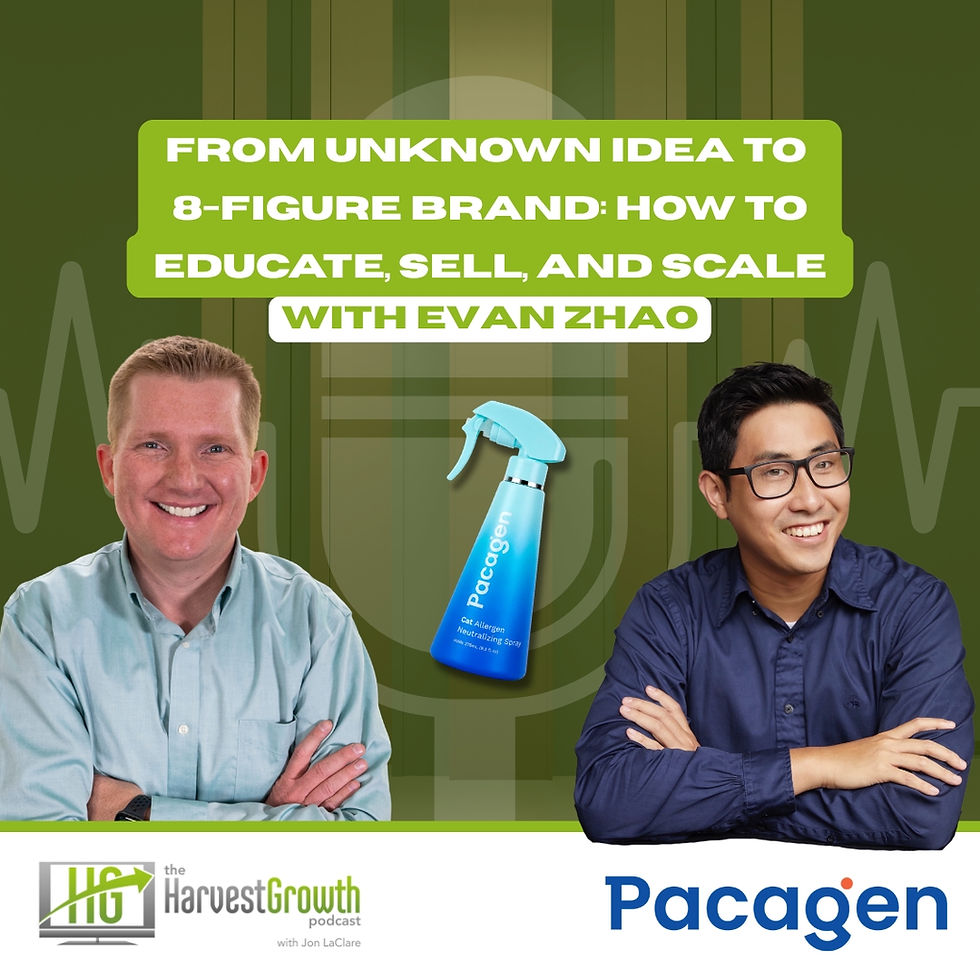
In this episode of the Harvest Growth Podcast, Jon LaClare sits down with Evan Zhao of Pacagen to discuss how his team developed and marketed a new kind of pet allergy solution designed to help people live more comfortably with the animals they love.
Evan shares the challenge of bringing a product to market when customers do not already understand the category. Unlike products built around familiar trends like magnesium, creatine, or protein, Pacagen had to educate customers on why pet allergies happen, how their solution works, and why it is different from traditional options.
The conversation dives into what it takes to build demand for a new product category, including how Pacagen approached longer sales cycles, performance marketing, website sales, Amazon, and customer education. Evan explains why products that require more explanation often perform better on a brand’s own website, where companies can capture customer information, retarget visitors, and continue educating them over time.
Evan also shares why lifetime value is one of the most important drivers of growth, especially for a product customers may come back to repeatedly. From customer service to packaging, scent, shipping, and the full product experience, Pacagen focuses on improving every touchpoint to make sure customers have a reason to return.
This episode also explores Pacagen’s work with shelters, where the company gives away free samples to help more people keep their pets instead of giving them up due to allergies. Evan explains why this is one of the few initiatives his team does without focusing directly on ROI — because helping pets stay in loving homes is valuable on its own.
In today’s episode of the Harvest Growth Podcast, we’ll cover:
How Pacagen created a new category in pet allergy relief
Why educating customers is critical when selling an unfamiliar product
How longer sales cycles impact performance marketing strategy
Why website sales can be more effective than Amazon for products that require explanation
How Amazon can serve as a demand capture channel
Why lifetime value depends on the full customer experience
How customer service helps improve product retention
Why product sampling can build trust, create goodwill, and support a larger mission
How Pacagen is helping pet owners and shelters reduce allergy-related pet surrender
You can listen to the full interview wherever you listen to your podcasts.
Or, click to watch the full video interview here!
If you’re building a new product category, marketing a product that requires education, or trying to improve long-term customer value, this episode offers practical insight into how product quality, customer experience, and clear messaging work together to support sustainable growth.
To learn more about Pacagen, visit Pacagen.com or search for Pacagen on Amazon.
Do you have a brand you’d like to launch or scale?
Visit HarvestGrowth.com to book a free consultation and learn how our team has helped generate over $2 billion in product sales.
Prefer reading instead of listening? Read the full transcript here!
[00:00:00]
Jon LaClare
Today's guest has already done what so many founders are trying to do. He built and sold one fast-growing consumer brand, and now he's building another company around a product that is truly unique, and that creates a challenge. When you launch a product that people already understand, marketing is really about standing out.
[00:00:19]
Jon LaClare
But when you launch something that creates a new category, marketing is about helping people understand the problem, believe in the solution, and take action. In this interview, we talk about how Packagen has quickly grown by combining science, education, and performance marketing. We dig into what it takes to develop creative that works, how to test messaging when there's no obvious playbook, and how to grow customer lifetime value after the first sale.
[00:00:46]
Jon LaClare
We also talk about Amazon, DTC growth, repeat purchase, customer acquisition costs, and what it takes to scale a unique product into an eight-figure business. There's a lot of practical value in this conversation, especially for anyone launching a product that customers may not even know to search for yet.
[00:01:05]
Announcer
Harvest the growth potential of your product or service as we share stories and strategies that'll make your competitors nervous. Now, here's the host of the Harvest Growth podcast, Jon LaClare
[00:01:21]
Jon LaClare
Over the past 20 years, our team has helped launch and grow hundreds of consumer products, generating more than $2 billion in revenue for our clients. On this show, we break down what actually works in product marketing, real stories, real strategies, and lessons you can put to work in your business right away.
[00:01:38]
Jon LaClare
Whether you're getting ready to launch or looking to scale what's already working, you're in the right place. All right. Let's jump into today's interview. I wanna welcome Evan Zhou. He is the co-founder of Pacagen. You can check them out at pacagen.com. It's P-A-C-A-G-E-N.com. As always, is, it's in the show notes.
[00:01:56]
Jon LaClare
But before you jump off and go check out their website, I wanna, again, introduce Evan and, and thank you for joining us on the show. And then if you could also tell us a little bit about Pacagen. What is the product? Just for those who don't know what it is.
[00:02:09]
Evan Zhao
Uh, thank you so much for having me, Jon. It's, it's a pleasure to be here, and I'm very honored.
[00:02:13]
Evan Zhao
So Pacagen sells sprays and then things to feed to your cat for cat allergies, dust allergies, and dog allergies. So what you can imagine is, as these allergies are spread in the air or on surfaces, we have a spray that neutralizes specifically those allergens and only those allergens, uh, very safely and effectively
[00:02:34]
Jon LaClare
That's a great way to summarize it.
[00:02:36]
Jon LaClare
I was gonna try to describe the product, but of course, nobody can do it better than you. I wanna-- let's go back to the origin story too, 'cause it's, it's interesting how you came up with this concept. You ran a previous business very successfully and sold it off in the beauty space. This is completely different in terms of products.
[00:02:50]
Jon LaClare
So what got you into this? What o-originally introduced you to the problem of pet allergens?
[00:02:57]
Evan Zhao
Well, back in twenty-twenty when COVID hit, uh, so my family has always been dog people. We really like dogs. And during COVID, they told us you couldn't really get a dog because you were walking outside, and that was super bad for everybody involved.
[00:03:14]
Evan Zhao
So we wanted to adopt a cat. So I went online, I searched, you know, kittens available for adoption, and there was only one kitten left in the area, so I, I signed up for it, paid like a small deposit. Um, we-- my wife and I went to go pick up the cat, brought, brought it home, and she immediately started having allergic attacks, uh, like asthmatic attacks, really severe ones.
[00:03:36]
Evan Zhao
And, you know, obviously she blamed me for this because I did not double-check with her on this. Uh, to be-- in my defense, she had been in cat cafés, and she had interacted with a bunch of cats before, so I think it was hard for me to know, but this is a really serious issue, right? So allergies. And we were just looking into all of the different things that people do for allergies, and honestly, all the solutions are not great.
[00:04:00]
Evan Zhao
They, they don't really solve the problem, or they actually just suppress your own immune system. So there can be long-term side effects, and it's not really dealing with the inflammation that the allergens are causing. Uh, and so we did a bunch of research. It turns out in my PhD, I was working on a special class of things that neutralize other proteins, which allergens are.
[00:04:22]
Evan Zhao
Allergens are proteins that your body mistakes as a toxin. And so what I was previously working on are these things called nanobodies, which are from the immune system of alpacas, and they are especially good at neutralizing other proteins. And so we took that idea, we scaled it up, right? We got these things from the alpacas.
[00:04:43]
Evan Zhao
No alpacas were harmed. Uh, we do everything using genetic engineering, and then we produce it using bacteria, and we put them into spray bottles, or we put them into something that you can feed to your cat. Uh, but that's why the company's called Pacagen. It's from alpaca, so alpaca generated. That's where everything comes from.
[00:05:02]
Jon LaClare
Yeah. It's funny, I, um, I have a, a cat allergy myself. It doesn't sound as serious as your, as your wife, so I, I get really itchy eyes, you know, not, not asthmatic attacks luckily. But I, I have a good friend that, uh, through my church, she's a, she's a widow, and I got introduced to her 15 years ago to kind of just help and, you know, be around and be there to help her.
[00:05:21]
Jon LaClare
But she has cats around the house, and, uh, I would go in there every time and, like, you know, just your eyes water by the time you leave, and it's, uh, it was always very difficult, um, for that. Again, not serious, but, but annoying enough, right? And at the time, you know, as you said, the only options really were, were not great, and what I would use is like a histamine, I think they call it a histamine blocker or whatever, and they kind of work.
[00:05:42]
Jon LaClare
They block the symptoms, but they make you feel real drowsy and just not yourself at all. So I love the solution you've come up with where it's you can be around and enjoy pets and not have to, you know, feel different in, in kind of, kind of in any way, right? Not have the allergies or the drowsiness or other side effects that can come.
[00:06:00]
Jon LaClare
So I'm really appreciative for, for your product and this technology. Um, h-how does it... Do you know anything-- Well, I'm sure you do. Can you explain maybe for the rest of us why is it alpacas? Like, what is it about them that created this, this, uh, genome or this whatever you wanna call it? I'm not scientific obviously, but how, you know, that makes it work, this chemistry that makes it work.
[00:06:20]
Evan Zhao
Of course. So nine out of the top 10 drugs that are currently selling in the United States are these things called antibodies. And what antibodies are, they are our proteins that our own immune system uses to neutralize other proteins. And so it turns out most of the issues that we run into, most of the diseases, cancers, other things, are caused by dysregulation of proteins.
[00:06:46]
Evan Zhao
So there's either too much of one protein or too little of one protein. And so what antibodies do is they bind to and neutralize, or they bind to and do something to another protein. And you can imagine this is very useful when you're designing a drug for a cancer, especially given what I just said, that most diseases are caused by having too much of one protein or too little of another protein, right?
[00:07:05]
Evan Zhao
So- People have been trying to find better versions of this stuff, and it just so-- And so they've been looking through the animal kingdom trying to figure out what could potentially be better. And there are two things that they've discovered. The first are these set of proteins called SCFVs, and they actually come from sharks.
[00:07:21]
Evan Zhao
We have no idea why sharks produce something that are so good at dealing with human diseases. But now when you see a lot of cancer treatments, a lot of them are based off this shark technology. And the other major class are these nanobodies that are based off the alpaca immune system. We think it's random luck, right?
[00:07:37]
Evan Zhao
So these animals just happen to evolve immune systems that are high, you know, very, very efficient at neutralizing other proteins. And the other benefit of, of these proteins, specifically the shark and the alpaca ones, is that they can be produced using bacteria, whereas the human antibodies need to be produced using human cells or mammalian cells, which have their own set of issues and make it like a hundred times more expensive than using bacteria to produce.
[00:08:03]
Evan Zhao
Um, and so for our product, because cost of goods sold matters so much for consumer business, we had to use something from alpacas or sharks because we needed to make sure that we could produce it at a price point that was reasonable for everyday Americans.
[00:08:18]
Jon LaClare
As opposed to like a prescription medication that might, you know, cost hundreds of dollars a month or something like that.
[00:08:23]
Jon LaClare
Yeah, very, very different for sure. So it is, as you've said, it's, you created a new category. Really there's, there's nothing like this. There was nothing like this on the market when you, when you brought it out, which is great. It, it, you know, it gives you a huge opportunity to enter a new space. But it's also a challenge 'cause you've got to convince people not only, not only educate them, and, you know, we can do that in a, you know, half-hour discussion that we have today, and people that are listening will end this fully understanding it.
[00:08:47]
Jon LaClare
But you gotta be quicker in most marketing efforts, right? So how did you overcome the hurdle of both understanding it and believing it, that it would work, right? This, this promise to rid you or, or at least soften your allergies?
[00:08:59]
Evan Zhao
Of course. Well, yeah, you're right. It's very challenging. Uh, in fa- in fact, most of the fastest-growing brands that we have today take advantage of some level of awareness from the customer, right?
[00:09:10]
Evan Zhao
So usually, what people do to succeed in consumer goods is they take something that's already pretty popular. So, for example, like magnesium is a popular concept for sleep, right? Creatine is popular for working out. Protein is popular for working out. So they take it, they put it into different form factors, and they then market that way.
[00:09:28]
Evan Zhao
That way at least if I'm like, "Hey, I have a protein crème brûlée," you understand what that means because I know what protein it means. I, I know it's important, and I get what crème brûlée is. Uh, for Spray, that gets rid of cat allergies, that's a little bit more difficult to understand. And in the current, I would say like meta game of w- meta and Google and all these other platforms for social media, you don't have that much attention, so you don't have that much time to explain to people exactly how your product works.
[00:09:58]
Evan Zhao
And so we've had to think about the way that we sell our product as pretty l- long life cycles, right? So instead of being able to convert someone off of one ad, we have to talk to them first about why they're having allergies and potentially what's going on with their immune system that is causing these things.
[00:10:15]
Evan Zhao
And then we then explain what the difference between our product is with other products. And conviction-wise, uh, we had one major data point that this could be a big category, and that is a cat food that Purina released called Purina Pl- Pro Plan Live Clear. And they have similar idea, which is let's create a protein that neutralizes the allergen, except their idea is they immunize chickens, and then they use the chicken's eggs, uh, that also had immunity against whatever you immunized the chicken for.
[00:10:47]
Evan Zhao
They use the chicken's eggs to make the cat food. And so that cat food is doing very well. Uh, you know, it scaled to nine figures very, very quickly, partially because it's Purina. But it gave us an idea that this is actually a pretty massive market that people are really interested in. And so once we had that conviction, we were willing to deal with these longer sales cycles.
[00:11:07]
Evan Zhao
And, you know, the other thing is our team, um, you know, my wife uses the product. We have conviction that the product works. And so the idea is, even if it's more difficult to sell on Meta, even if it's more difficult to sell in all the different channels, we have belief that our lifetime value of a customer is still gonna be very long, a- and we've seen that throughout the years.
[00:11:29]
Evan Zhao
And so that enables us to commit more to the marketing and make sure that more and more people can, can see the product.
[00:11:37]
Jon LaClare
You do a great job of explaining difficult things or hard to understand things, so thanks for keeping things sim- in simple terms that we can really understand. That's helpful. Um, and it is a, you know, it is a challenge marketing something new for sure and to bring it out.
[00:11:49]
Jon LaClare
And I think by our last conversation, if I remember right, you spent about a year developing the technology to get it right and ready for market, and then what was... When you got it ready, you now launch, what was the first indication that you really, maybe it's before launch, I guess, that you knew you had something?
[00:12:04]
Jon LaClare
You mentioned, you know, Purina, seeing other products, but your product specifically, when did you know, "Okay, we got something here. This is gonna work"?
[00:12:12]
Evan Zhao
Um, you know, just from my last business, I, I think that cost per click, especially when you're optimizing for conversions and not just for click, you can, you can fool yourself by optimizing for click.
[00:12:24]
Evan Zhao
But cost per click on Facebook ads especially will give you an indication on the latent demand in the market. It might not tell you how big the market is, but just the latent demand, like how badly do people want a product? If you can get a cost per click like lower than a dollar in a, a normal like wellness category, that's...
[00:12:44]
Evan Zhao
You're looking at something that has so much demand that you can make sure that you can get to a million dollars a month pretty easily. And so that was our first indication, was that people were just clicking on the ads, which meant they really care about their cat allergies, they really care about their other allergies, and they're really looking for a solution.
[00:13:00]
Evan Zhao
Um, now converting them is a different story, right? Obviously, there's a lot more work to be done, but if they click on the ad, it, it does tell you something about how much they want the product
[00:13:12]
Jon LaClare
That's a good way of describing it. And you mentioned the previous product that you launched and, and eventually sold the business.
[00:13:18]
Jon LaClare
Were, were very successful with it. What-- It, it was in the beauty category, so again, very different product, but what learnings did you take beyond what you just mentioned from that previous launch or previous, uh, marketing campaign that have been helpful in this new business?
[00:13:33]
Evan Zhao
Of course. So we've been working with science-baked-based products for a long time.
[00:13:38]
Evan Zhao
I would say that nowadays that's no longer really a differentiator. And I would say even back then, like that was, uh, you know, four or five years ago when we first started the first business, that was also not a differentiator because everybody can say they're science-backed. There's, there's no like, there's nobody checking if there's actual science backing products that say that they're science-backed.
[00:13:58]
Evan Zhao
And so it's not a real marketing advantage. Uh, I would say that through all of it, what I've learned is if you have something special, you shouldn't be looking for extra efficiencies in marketing. And using these things as, you know, you could try to go viral, you could try to, you know, get as much PR as possible, but the reality is most things that scale nowadays have to rely on performance marketing, at least somewhat.
[00:14:23]
Evan Zhao
Uh, there are few brands that can scale without performance marketing, and those are very, very rare edge cases, and you just have to get performance marketing to work. The thing that a better product gets you is better LTV, right? And if you can make sure that people keep coming back to your product and you have confidence they'll keep coming back, then you can commit more to marketing, and it gets you an ability to get to scale much more quickly and get people talking about the product.
[00:14:50]
Evan Zhao
And as long as you have that kind of lightning in a bottle, making sure that people can talk about the product, you'll have more word-of-mouth purchases, which gets you slightly more efficient customer acquisition costs anyways. And it just makes sure that your business is in a healthy state much more quickly.
[00:15:05]
Evan Zhao
So I would say that's the biggest learning, is a lot of people think that having science or having a new molecule or a new thing will help you with marketing. I would say it's-- that's a pretty-- I think, I think it's pretty naive. Uh, people don't really care that much if something's new, in fact, like we were talking about.
[00:15:22]
Evan Zhao
Uh, people like creatine, people like magnesium. They know what it does. It's safe, you know, it's effective. And so you don't really have an advantage over those companies. And in the Meta auction place and the Google auction place, you're competing against everyone. And so you should really be looking for efficiencies on having a better product, and that means that people should come back, the repeat rate should be better, and you should be able to make sure that you can make back the money from the second to third to fourth purchases.
[00:15:48]
Jon LaClare
I wanna pick apart a couple things you said just to, for clarity for our audience sake, 'cause I really think what, you gave a lot of nuggets there that are helpful. One of the things, and I, and correct me if I'm saying this incorrectly on, in your mind, but I think what you're saying is, you know, viral marketing, which is o- often considered organic, right?
[00:16:03]
Jon LaClare
You make a great funny video, and it kinda goes off on its own and million, get millions of views or whatever. Absolutely can work. It's hard to repeat. It's hard to scale. It's hard to control, and it's harder to do today than it was, uh, previously, right? It just, the, the world changes. Performance marketing, which, you know, I would call paid media, same thing, right?
[00:16:21]
Jon LaClare
So you're, now you're paying for media, whether it's on Facebook, Instagram, or TV, right? Any platform where you're, you're buying views of your creative or, or, you know, of your advertising to drive to your site. So just to clarify those two things. Um, and I, I love how you also connected it back to the lifetime value.
[00:16:39]
Jon LaClare
So the better the product, getting that, the other side of performance, right? There's performance marketing, but how your product performs for them once they receive it is so important. You get it in their home, they have great results, it solves their problem, especially with a unique product like yours, they're gonna come back, they're gonna buy more from you and, and keep that business growing.
[00:16:56]
Jon LaClare
So, uh, yeah, just wanted to connect all those, uh, in, in another way, in my own words at least for our audience. So thank you for sharing that part. You and I previously talked about too, the difference... Thank you. The, the difference between Amazon and website sales for your particular business, and where currently your business has, is doing better or is bigger on the website than it is on Amazon.
[00:17:17]
Jon LaClare
And every conversation I have is different. I just spoke with someone this morning that is the exact opposite. They're like, "We can't get our website to work. The economics don't work," et cetera. But so almost all of their sales are on Amazon, and that works for some. But I, I, I prefer the model you use for a lot of reasons.
[00:17:34]
Jon LaClare
Why, why do you, I guess, prefer that model to focus more on the website sales than on Amazon sales, at least with the current structure?
[00:17:43]
Evan Zhao
Of course. So Amazon is great, right? I, I think there are many very successful businesses on Amazon I do think for products that require more explanation, you are going to naturally need to send people to your, to your website, uh, and not to Amazon, just because you have less space on Amazon to talk about what your product does and all of the unique factors on it.
[00:18:06]
Evan Zhao
And the other thing is, we talked about how the, the cycle of sales is much longer for these more complicated products. I need people to learn more about it. And so sometimes it might take three visits before they convert, and that's a little bit more difficult to track on Amazon. But in addition, usually if they visit your website, you get their email, you get their phone number, and so you can retarget them, you can give them more information that helps them convert at a later time point.
[00:18:33]
Evan Zhao
And that part's a little bit missing on Amazon. And so for us and businesses like us, I think the majority of the sales end up being on the website because of that reason, is it's easier to convert people there. And Amazon becomes a demand capture device, meaning if people have heard about you and they already wanna buy you, then Amazon becomes great, right?
[00:18:52]
Evan Zhao
It's easy to access. People trust Amazon. They trust that it's a, a good place to order from, and there's gonna be a huge fraction of people that would never order you if you weren't on Amazon. And so at this point, I would say Amazon's become a you need to play and you need to play a-- you need to pay a little bit to p- to play.
[00:19:10]
Evan Zhao
But, you know, as a product that requires a lo- longer life cycle, you need to make sure that people are getting educated, otherwise you won't be able to get the sales in, in the first place.
[00:19:19]
Jon LaClare
Well said. And, and yeah, I think you made a great point. Amazon is absolutely important. And, and for some it should be the primary, but there's a lot of reasons if you can make your, your website the primary, it's very helpful for the longevity of the business, getting contact information, et cetera.
[00:19:33]
Jon LaClare
Another reason I would add, and I think you kinda said this, but I'll say it in a different way, is because your product is so unique, if people aren't aware of it, they're not searching for it. So Amazon is kinda like a Google, right? If you know what you want, you go on there and you make... you know, you pick from choices available.
[00:19:46]
Jon LaClare
But if you've got something that's totally unique, no one's looking for it. They just don't know it's there. That's where meta or social media platforms and similar TV as well, can be a great vehicle for selling something unique, introducing somebody to, to this product. And, and with that said, you've gotta be pretty quick in your ads, right?
[00:20:05]
Jon LaClare
Whether it's images or video, you gotta capture their attention quickly with, with an explanation to at least capture interest. What works best in your marketing to, to do that? What have you seen work best currently on meta, let's say, or other social media platforms to capture attention and make sure people watch the videos and, and pay attention to your business?
[00:20:24]
Evan Zhao
Oh, that's a, that's a multimillion-dollar question. I would say, yeah, I mean, uh, it probably alters by month and every time Meta changes their algorithm and how they think about how to target people, it will change as well. Uh, I would say, you know, at a certain point in time, people really love watching cute cats, right?
[00:20:43]
Evan Zhao
So if we had a cute cat in the first five seconds of video, we noticed people would just click on it more. And, and that sometimes it performs, sometimes it doesn't, depends on the month. Uh, you know, for us though, we don't base performance marketing off of pure metrics, meaning like we look at the hold rate, we look at the, you know, five-second view rate.
[00:21:04]
Evan Zhao
But in reality, what matters for us is that no matter what happens, we try to get you some information about the business. And so, you know, even if the first five seconds are a cute cat and people hold the five seconds, and then they get maybe get like three seconds of some person talking, that's not that useful for us because they haven't really learned anything about the business.
[00:21:24]
Evan Zhao
We talked about the multiple touch points. It's not really adding anything for our sales cycle. And so we like to think about even if we're gonna get three seconds, even if we're gonna get two seconds, what information do we want the person to get so that the next time they visit, the third time they visit, they are able to convert or they're able to at least learn more.
[00:21:43]
Evan Zhao
Um, and that, that's probably a little bit more unique for our business just because it's a new category, like you were saying. And, you know, that whatever works there wildly varies, right? Uh, ugly ads are in it now. So people like seeing things that are not perfect because it looks less AI. Uh, other people say AI works really well.
[00:22:02]
Evan Zhao
We haven't seen it work that well yet. Uh, in terms of like the AI Pixar-style generated ads, we have not seen those work. And it, it truly depends on the month and how Meta is feeling.
[00:22:16]
Jon LaClare
I d- it does change, and variety we've found to be key, and, you know, you can see what is working best right now for a competitor or somewhat similar product may not work for you.
[00:22:26]
Jon LaClare
It just comes down to testing, like you're saying, and, and, and being flexible from one month to the next to really pay attention to the business and the metrics to see what is working and make sure you're, you're on top of it. 'Cause like you said, you can't ignore it. It could work phenomenally well this month, drive a ton of business very profitably, and the next month not work at all or, or less, right?
[00:22:44]
Jon LaClare
It's just being able to watch those metrics and make adjustments along the way. One of the things you previously mentioned too on the importance of, uh, or, or I guess factors that drives your success is the lifetime value. And, you know, I previously talked about how you've grown that fairly significantly over the past several months or a year.
[00:23:00]
Jon LaClare
What are some ways that have, have worked or things that have worked in your business to help increase your li- lifetime value that might be helpful for our audience with their businesses too?
[00:23:09]
Evan Zhao
Of course. Uh, I got yelled at very early on in my career about trying to outsource customer service. And, uh, you know, Peter Rahal was the person that yelled at me.
[00:23:19]
Evan Zhao
Uh, he at the time was running a, a private equity fund, and he was asking... You know, I was cons- you know, I was asking him for potential funding, and he was like, "Who's doing customer service?" And I was like, I was like, "I hired a junior person to do it." And he was like, "You need to offboard them from customer service, and you need to be doing a lot of your own customer service," and that's how he runs his businesses.
[00:23:38]
Evan Zhao
That I think is the core of LTV, which is even if your product like cures cancer or does amazing things, you're not gonna have good LTV unless the entire product experience is optimized for the person that you're designing it for. And no matter how much you think you can optimize for the customer experience before you launch a product, there are always 20 different things you can improve to make sure the experience is better, and we've seen that.
[00:24:05]
Evan Zhao
So our initial launch, we had a scent in there that I think didn't fully cover up the protein smell, and so now we have a new version of the scent that I think will drastically increase LTVs. Our shipping experience, the entire like spray bottle experience, the entire, uh, filling up the spray bottle experience, everything in that entire Customer, like, flow.
[00:24:29]
Evan Zhao
All of that stuff matters for making sure they'll come back and they will purchase more product. Because if they have a, a good experience, they're gonna come back. Um, and that's, that's a little bit unique to our company, we're, we're not really a single purchase company, but we're also not a subscription primarily company.
[00:24:45]
Evan Zhao
So we have subscription available, but the majority of our repeat customers do not start on subscription. And so we, you know, we optimize it a very different way. But for us, our north star is will the customers come back, and how do we optimize the product experience to make sure they come back? And the way to do that is to do as much customer service as we can.
[00:25:05]
Evan Zhao
Every team member does customer service here, and we try to just make sure we take in all of this feedback and improve the, the entire experience.
[00:25:16]
Jon LaClare
It's one of the reasons I love doing these interviews is there's always something else we can be thinking about in our business. And you may have, as you said, the perfect product that cures cancer or whatever that, you know, matches the promises that the customer's looking for.
[00:25:28]
Jon LaClare
But even if they're happy with the experience, that it's working really well for them, someone else in their marketing, right, on social media and TV, whatever, is gonna be promising something more. Now, they may not deliver, but they're always gonna hear that. We've even seen that with our business as well.
[00:25:40]
Jon LaClare
We've had a couple clients over the years where back in the day, you know, we do a much better job at communicating right now, I think, which is better. But in the day, we thought, "Oh, results are great." So my, you know, I-- It's a video marketing agency. We launch products, we grow campaigns, et cetera, and we're hitting these targets that we had one client that I remember that was, like, two, almost three times the goal for his ROAS or return on ad spend.
[00:26:01]
Jon LaClare
So we're like, "Oh, this is great. It's all working." And I-- you know, one of my employees was kind of in charge of that and let the communication lapse a little bit. Wasn't always in, in talks with him. Sure enough, he hears from other people like, "Oh, you should be getting twice that in, in your ROAS," or, or whatever.
[00:26:15]
Jon LaClare
And, uh, so he left, came back later. Of course, they couldn't deliver what they promised. But they're gonna be hearing things like that, right? You're-- There's always the temptation, no matter how well your product or your service as a business is performing, the-- it's gonna be in the back of their mind, could it be better, right?
[00:26:30]
Jon LaClare
And, and communication is such an important part of that. And, you know, you call it customer service, however you wanna word it, right? It's about that connection with our customers, making sure they're happy with the entire experience, and it makes really all the difference, uh, to, to not only get customers but really to keep them long term and keep them referring to others as well.
[00:26:48]
Jon LaClare
You and I previously talked also about, um, free samples that you give away to, to shelters. You mentioned something to me that I didn't realize. It, it makes sense, sadly, but a lot of pets are given up because of allergies. I just never connected with that, right? Like, like, you know, in your case, you could have, right?
[00:27:04]
Jon LaClare
Not realizing that your wife was allergic, you get home and some people would have taken to the, the cat to the shelter. So you've helped to resolve that, so you've given some, some free samples, uh, which is a great way to give back. Um, how has that helped your business? And, you know, whether that's just in, you know, feeling good or growing the business or whatever, but this free sample approach and really helping the shelters, how has it helped your business?
[00:27:28]
Evan Zhao
Uh, you know, I, I'm a pretty math-focused person. This is one of the few things that we do where I don't look directly for an ROI. And like you were saying, in every piece of business, sometimes you just have to take a leap of faith. And for us, one of, one of our team members convinced me to take the leap of faith.
[00:27:48]
Evan Zhao
They were like, "Here's much... how much it's gonna cost us to do all these samples. Let's just give them away." And for multiple reasons, like you were saying, the first thing is we can help people keep their cats. The second thing is, you know, it's an effective product. So instead of paying Facebook, right, $100 per customer or $50 per customer, maybe I can just convince someone to buy the product naturally, which is we'll just let them use it first.
[00:28:12]
Evan Zhao
And we have not been able to track exactly how many of our customers we got that way. But, you know, one, it makes our team feel great about what they're doing, because how many other companies can just give away a bunch of product that is efficacy-based, and they need people to try it out and use that as a, you know, a big...
[00:28:32]
Evan Zhao
Spend a big portion of their time doing that. Uh, so it makes our team feel great. And then in addition, I'm sure there's gonna be payoff in the future. It's one of-- you just have to have a leap of faith.
[00:28:42]
Jon LaClare
Yeah. And, and at the end of the day, giving back and helping, and I can only imagine, again, it's hard to track, but you help the shelters as future people come to drop off like, "I love this cat, would love to keep it, I can't."
[00:28:54]
Jon LaClare
Well, now the shelter has a solution. "Hey, we have this thing you might wanna try." They probably are, I'm sure, helping cats not to be dropped, or dogs or whatever, not to be dropped off at the shelters in the first place. So yeah, I love that. It's a great way to give back. And again, some things are hard to track.
[00:29:07]
Jon LaClare
Worst case is you're, you're helping pets to find good homes or, or stay in good homes. Well, Evan, this has been a lot of fun. You, you've shared a lot of information. This is... I'm really excited to pull this together and share with our audience. Is there anything I didn't ask you that you think could be helpful for our audience?
[00:29:22]
Evan Zhao
Um, I can't think of that much. This is... I, I-- like I said, I watched a bunch of episodes, and I'm really excited to be here, and thank you so much for inviting me.
[00:29:32]
Jon LaClare
Absolutely. Yeah, it's been a pleasure to have you. And I, I wanna encourage our audience again, if you go to Pacagen, P-A-C-A-G-E-N, .com, you can find the product on Amazon as well, and some local retailers too.
[00:29:44]
Jon LaClare
So go check out the, the website. Evan, I really appreciate what you've done with this product to help a lot of people like me, right, with... that have allergies to, to pets, to overcome them and without feeling drowsy, right, and other side effects, and without harming the animal in any way as well. So what a great thing you've done for, for me and for a lot of people, and I really appreciate that.
[00:30:01]
Jon LaClare
Well, for our audience, if you wanna take the next step in growing your business, you can visit harvestgrowth.com. There you can connect with our team directly. You can book a one-on-one conversation focused on your business. Well, for today, thank you for listening, and we'll see you in the next episode.


Comments