
From Amazon to Retail: The Omni-Channel Strategy Behind Jaxon Lane’s Success

Updated: May 18
Over the past 20 years, the team at Harvest Growth has helped launch and grow hundreds of consumer products, generating more than $2 billion in revenue. On the Harvest Growth Podcast, we break down what actually works in product marketing—real stories, real strategies, and lessons you can put to work right away.
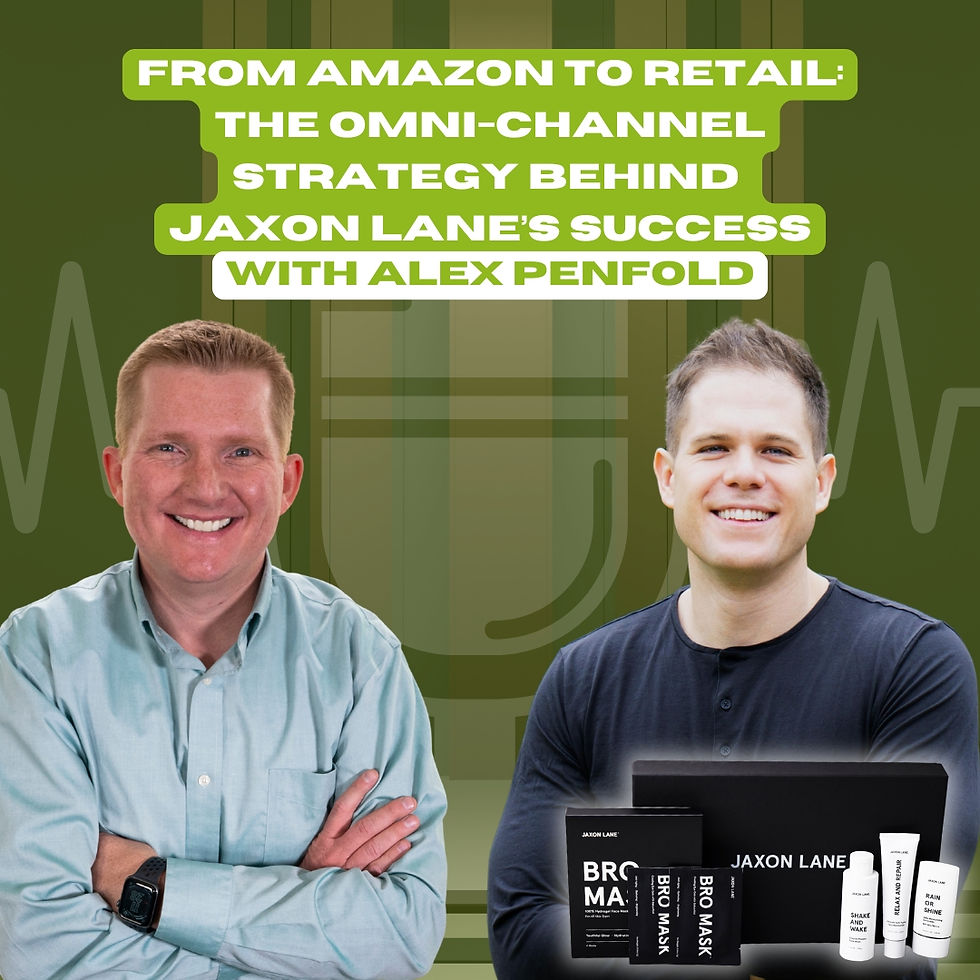
In this episode, Jon LaClare sits down with Alex Penfold, co-founder of Jaxon Lane, to share how he built a leading men’s skincare brand by combining Amazon dominance, strategic PR, and a smart omni-channel expansion strategy.
Alex explains how starting with a niche focus on long-tail keywords helped Jaxon Lane stand out on Amazon—even as competition and costs increased. From there, he leveraged PR exposure, including major publications and editorial features, to drive awareness, organic growth, and retail demand.
The conversation dives deep into how Jaxon Lane expanded beyond Amazon into direct-to-consumer, Meta advertising, TikTok, and major retail partners like Urban Outfitters, Bloomingdale’s, and Saks Fifth Avenue—turning each channel into a growth engine that feeds the others.
Alex also breaks down what it really takes to win with PR, why having a compelling product story matters more than just launching something new, and how consistent product innovation keeps brands relevant year after year.
If you’re building a product brand and wondering how to scale beyond a single channel—or how to fund growth without outside investment—this episode offers a practical roadmap from someone who’s done it successfully.
In today’s episode of the Harvest Growth Podcast, we’ll cover:
Why niche positioning and long-tail keywords drive early Amazon success
How PR exposure can accelerate brand awareness and organic growth
The role of retail as both a revenue channel and top-of-funnel marketing
Why omni-channel strategies outperform single-channel businesses
What it takes to succeed on TikTok (and why it’s a completely different model)
How to approach influencer and UGC strategies more efficiently
Why product quality and manufacturing decisions directly impact growth
The advantages and challenges of bootstrapping vs. taking outside investment
How to fund growth by reinvesting profits across channels
And so much more
You can listen to the full interview wherever you listen to your podcasts.
Or, click to watch the full video interview here!
If you’re launching a product, scaling on Amazon, or looking to expand into retail, PR, or TikTok, this episode will help you think more strategically about long-term growth.
To learn more about Jaxon Lane, visit jaxonlane.com or search for their products on Amazon. or search for their products on Amazon.
If you enjoyed this episode, be sure to subscribe and leave a review — and we’ll see you next time on the Harvest Growth Podcast.
Prefer reading instead of listening? Read the full transcript here!
[00:00:00]
Jon LaClare
Today's guest built a self-funded beauty brand into an eight-figure business by creating momentum across Amazon, e-commerce, PR, social media, and brick-and-mortar retail. We're gonna talk about how they grew it profitably, found a niche that worked, and turned smart positioning into long-term brand success.
[00:00:20]
Announcer
Harvest the growth potential of your product or service as we share stories and strategies that'll make your competitors nervous. Now, here's the host of the Harvest Growth podcast, Jon LaClare.
[00:00:35]
Jon LaClare
Over the past twenty years, our team has helped launch and grow hundreds of consumer products, generating more than two billion dollars in revenue for our clients. On this show, we break down what actually works in product marketing, real stories, real strategies, and lessons that you can put to work in your business right away.
[00:00:56]
Jon LaClare
So whether you're getting ready to launch or maybe you're looking to scale what's already working, you're in the right place. All right, let's jump into the interview. I'm excited to be speaking with Alex Penfold. He is the co-founder of Jackson Lane. Now, it's primarily a male skincare company. At least that's maybe the most famous product they have is focused on that.
[00:01:16]
Jon LaClare
We're gonna dive into how he's found success already, what's next for his business, but he's got some great stories and really interesting products that we're gonna talk about during this interview as well. First, Alex, welcome to the show today.
[00:01:28]
Alex Penfold
Thank you for having me, Jon. It's a pleasure to be here.
[00:01:31]
Jon LaClare
Likewise. I'm glad, glad you could join us today. I know you're super busy. I appreciate you taking the time. So first of all, if you could share, uh, a little bit about Jackson Lane and your core product or core products, just to help our audience be a little more familiar with what your company is and what you sell.
[00:01:47]
Alex Penfold
Of course. Well, it all started eight years ago. Uh, my wife and I were, uh, you know, using sheet masks that her best friend had brought from South Korea. And, uh, and, you know, I started putting them on and really noticed a great change in my skin. Uh, you know, things were looking great for date night or going for weddings and different outings and things like that.
[00:02:07]
Alex Penfold
But then they were, uh, definitely sized not proportionately for my face, so they didn't go back far enough into my jawline. And if I ever had any facial hair, the bottom piece of a sheet mask or a face mask, whichever one you wanna call it, would just hang over. And you have people online sort of like cutting them and doing different things.
[00:02:25]
Alex Penfold
And, uh, and so we saw an opportunity to create a sheet mask designed with men's faces in mind and launched the Bro Mask. So that was the, the beginning of our, um, you know, like adventure into launching Jackson Lane and, uh, and, you know, found great success with this launch product. And then since then we've continued to grow, uh, you know, our, our line of skincare products.
[00:02:51]
Alex Penfold
Uh, and, uh, we're here eight years later talking with you today, so
[00:02:56]
Jon LaClare
Yeah, I'm glad you are. I, I'm really excited to, to share your story. I think it's really cool how you came up with this idea in the first place. I think back to, and you're right, it was kinda like the time of COVID or whatever. My-- I have three daughters, and of course, my wife as well, and one son.
[00:03:09]
Jon LaClare
But the three daughters care about face masks more than my son. And so we did a couple of times where, you know, they were home for Christmas from college or whatever, and brought the sheet masks home, and I indulged them, right, and put one on. And like, I didn't really wanna be sitting there with a bright pink face mask on, right, a sheet mask on my face.
[00:03:27]
Jon LaClare
But I'm like, you know, I'm with my daughters. As long as nobody comes and visits us while this is on. But it feels amazing afterwards, right? It's like you do realize you're actually taking care of your face. And so I was excited to find the Bro Mask. I, you know, heard about the business a long time ago, and, uh, it's a great concept for those that, "Hey, I still wanna have benefits.
[00:03:44]
Jon LaClare
Like, I wanna have nice skin, but I don't wanna wear a pink face mask," right? "I want something designed specifically for men." So I get it. I love it. I can see why it really took off, uh, pretty quickly. Um, one thing I wanna, uh, dive into is you, you talked about how you originally developed it, you know, with your wife, and that wasn't just conversation.
[00:04:01]
Jon LaClare
She literally runs the business with you as your co-founder and your partner in the business. What's that like for those that might be listening and thinking, "Should I get my wife or my spouse or whatever involved in the business?" How has that been? If I can ask that. I
[00:04:13]
Alex Penfold
won't
[00:04:13]
Jon LaClare
tell her. Well,
[00:04:13]
Alex Penfold
it depends on, uh, your relationship and- how you, uh, communicate and get along with each other. So I mean, I've spoken to multiple people who have been like, "I could never do that with my wife," or, you know, vice versa with their husband or whatnot. So, um, you know, I think, uh, we, uh, you know, have the skills that are completely different. We have very different personalities and, uh, we've been able to make it work.
[00:04:36]
Alex Penfold
We, we've, you know, even had business counselors come in at, at different stages to help us work through problems or, or any tension that we might have. And so that's always helped a lot and, uh, and you know, we've, we've definitely, uh, you know, in a good place today and, and we wouldn't have been there, here today if it wasn't for working 'cause, you know, I don't think you can continue working on a company for eight years together if you can't figure it out.
[00:05:00]
Alex Penfold
So, um, but it's definitely not for everybody. And then also, uh, none of it comes up, you know, sorry to interrupt, but, uh, uh, I think too, uh, you know, you know, having, uh, your finances all in one bucket in a house is also incredibly challenging. So, um, you know, I could talk more about that, but we did that in phases and, uh, and so, you know, we, we've pieced it all together over the years, I think
[00:05:26]
Jon LaClare
Y- you've gotta make it work at the end of the day, eventually, right?
[00:05:28]
Jon LaClare
When you're working full-time on the business be- you know, both of you are in, as opposed to if sometimes a business owner may have a spouse that's working a, quote-unquote, "normal job" or whatever, and providing those early days where it's, it's more difficult. So it does force you to, to jump in and, and surely make this, make this happen.
[00:05:44]
Jon LaClare
I think what you said, you know, whether we're thinking about working with a spouse or a business partner of any type, it is that importance of how do you balance each other, right? So it's, you mentioned you have different personalities, different strengths, and playing off those. So again, whether it's your spouse or whether it's a business partner, it's finding that partner or frankly employees, right?
[00:06:02]
Jon LaClare
That are gonna be able to balance you and, and help where you might be weak. You know, we all have weaknesses, uh, where somebody else might be strong. Um, I wanna talk about the, the men's healthcare line 'cause it's obviously a niche, right? So it's a big niche. There's a lot of people that, that buy that product, but it's smaller than women's skincare in general so far, right?
[00:06:21]
Jon LaClare
At, at the starting point. But there's benefits to that, to being in a niche. And specifically, you and I had a previous conversation on how that has helped on Amazon. So how has it helped to be successful specifically on that channel, on Amazon, by being in a niche like that?
[00:06:35]
Alex Penfold
Uh, you know, as, as, you know, we discussed earlier, uh, you know, skincare, it's a very saturated market.
[00:06:43]
Alex Penfold
It's incredibly difficult to stand out. Uh, and so when you go to market, uh, and you start running your PPC advertising, your, your, your, your targeted long-tail keywords can lean into your niche. And so, uh, you know, for instance, for us, we can do, you know, like the skincare for men is not as competitive as skincare, right?
[00:07:03]
Alex Penfold
And so what- what- whatever it may be, um, you know, you need to Whatever your product is, if you can carve out and separate yourself from the broader market and then, uh, you know, optimize, uh, within that zone and, uh, gain organic rank, uh, you know, being that top five, being the top ten, uh, for a lower volume search word, it really helps in the, you know, really builds your listing.
[00:07:30]
Alex Penfold
And then as you start to rank within your niche, you can then, uh, you know, start to rank for more of the broad general keywords. Uh, so it's sort of like a two-stepped approach going, uh, you know, going specific first and then once you start to grow, you can branch out into larger areas. But, um, you know, I think that that has definitely helped us, uh, especially as, uh, some of the, you know, larger brands, especially in the last two years, have jumped onto Amazon as well, uh, making, you know, cost per click go up and just general, you know, competition increasing, uh, for, for everything.
[00:08:05]
Alex Penfold
So
[00:08:07]
Jon LaClare
Yeah. So it helps to be first, right? Or one of the early ones in a specific category, whether that's a category or whether it's long tail keywords, you know, within a category. But finding that sort of niche. You know, even in a, a broad category, you know, our listeners might be-- who knows what they're selling, right?
[00:08:23]
Jon LaClare
So but you might have something that you've got a lot of competition. But if you can, if you can sketch out a section of the competition, you know, a specific long tail keyword or se- or, or set of keywords where you dominate, that can really help you. And it may be difficult to get, you know, really broad ranking, um, but niche can, can work also very well.
[00:08:41]
Jon LaClare
And you've built a great business, a very successful business on Amazon doing just that and, you know, being a really a number one player in, in many categories within Amazon. We've also talked about the importance of omni-channel strategies, of being elsewhere besides Amazon. How has your business grown outside of, you know, your first successful channel of Amazon onto website sales and, and elsewhere?
[00:09:05]
Alex Penfold
Yeah, I think if it wasn't for, uh, the PR that we received from the launch of our product. So, you know, not only are men doing skincare, but they're also doing sheet masks and face masks for men. You know, it was kind of like a, a good catchphrase story, great for PR, good for editorials to write about GQ, Men's Health, Esquire.
[00:09:23]
Alex Penfold
Um, uh, we got a, a weekend edition piece in The Wall Street Journal. Um, so, so basically that really helped get the word out, helped us on Amazon grow organically there. Uh, but then, you know, we had retailers calling us all of a sudden. Um, so, um, you know, Urban Outfitters was the first retailer that was interested.
[00:09:42]
Alex Penfold
Urban Outfitters really likes to get on, uh, trending, uh, products at-- in the very early stages, so it's a great kind of launch, uh, retailer for new products if you happen to match their product fit. Uh, and so, uh, Urban Outfitters brought us on. Uh, we then launched with Mr Porter, which is the net, you know, m-men's side of Net-a-Porter.
[00:10:04]
Alex Penfold
And, uh, and from there it was like Bloomingdale's and Saks Fifth Avenue and, you know, the various retailers over, over the, uh, years. But, uh, um, that, uh, you know, led us into this omni-channel business where we're, we're, you know, doing the D2C side, uh, we're doing the meta advertising, which is very much a pay-to-play, but then how do you finance that side if you aren't funded, right?
[00:10:27]
Alex Penfold
And so, uh, we have been bootstrapped since the beginning and, uh, and still are today. And so we use momentum from the growth on Amazon, uh, and, uh, and then use that to fund the D2C, you know, marketing spend for the, you know, the Meta, Google, um, now TikTok. Um, and, uh, and then also retail is a great top-of-funnel strategy too.
[00:10:53]
Alex Penfold
Um, even if the, you know, the math doesn't kind of like pan out exactly as like a hyper, you know, super profitable channel, uh, in a lot of, in a lot of ways, depending on the retailer. But, uh, that is a great way also to get extra visibility and then, you know, bring people back to either Amazon or, or your own site for, um, for the long term.
[00:11:13]
Alex Penfold
So
[00:11:14]
Jon LaClare
It's really about finding ways for your audience to hear about you or find you, you know, learn about the product, especially when you've got something that's pretty unique, uh, out, out there in the marketplace. I like how you talked about retail can be part of that strategy. So we often think about getting to brick-and-mortar retail as the end destination, and we've gotta use awareness tactics to drive people to stores so when they walk down the aisle, they see your product, they wanna buy it, they know what it is, right?
[00:11:37]
Jon LaClare
And that is true. You've gotta have some of that awareness. But in other ways, brick-and-mortar retail can also serve for people finding for the first time your product, and they may or may not buy it. You know, they may go to Amazon later on and buy it. Or if they do, they buy it, they bring it home, have a, a good experience with it, and then come back and buy from you in, in digital ways.
[00:11:56]
Jon LaClare
So it is... I like how you talked about it's, in some ways it's truly top of funnel. You've gotta get awareness into retail, you know, depending on retailers you work with, but it can also be used as a true awareness vehicle. The other one you talked about, and I wanna unpack this a little bit, is PR. So you've had some, uh, fantastic PR exposure on video, a lot of articles, you know, video being TV.
[00:12:15]
Jon LaClare
A lot of articles, et cetera, over the years with some major publications and major players that have shared your story. What do you think has helped you, uh, to be successful in the PR space that might translate to some of our listeners' businesses as well?
[00:12:29]
Alex Penfold
Well, again, I think it comes back to that, um, you know, is your product a good fit for an article?
[00:12:38]
Alex Penfold
Um, and so, you know, this de- definitely does not fit, uh, you know, everybody's product. Like, you know. So we launched the Bro Mask, right? It's a catchy name. It's whether you love it or you hate it, um, it's something to talk about in the press, right? And so, uh, and then at the end of the day, when you're scrolling through the, the gift list for, like, best products for your man over the holiday, and you're scrolling down, is the packaging a good fit for, for, for something like an article that's being written?
[00:13:08]
Alex Penfold
And so, um, if that is the case, and you do have a catchy product that an editor wants to write about because, you know, he thinks he's going to get clicks, he or she's gonna get clicks, you know, that will then deliver, uh, you know, affiliate traffic to Amazon or to your website, to retailers, depending on, you know, if you're in retail, that type of thing, um, that is going to have a big impact.
[00:13:29]
Alex Penfold
So, um, I know that, uh, for us too, the fact that we launched with one hero product, and then over the years we have rolled out, you know, we're up to now ten products. Um, but then w- you know, we didn't kinda come to market with five products and then Uh, you know, the story was written once and then that was the...
[00:13:49]
Alex Penfold
Like, you know, there's, there's, there's what do you come back and keep touching base with your contacts about? Uh, and so we've been able to get everyone excited about, you know, the, the, the products we've launched since the original product, and that just reengages the press cycle and, you know, gets everybody talking about you again over and over again, year over year.
[00:14:09]
Alex Penfold
Um, and so you obviously don't want to get into some flywheel where you're constantly launching new products because that's incredibly expensive. Uh, but if you're focused on the products you're launching and, uh, you know, make sure-- You know, for us, the development for each product takes on average about a year, um, going through formulation development and making sure that they're going to be the best in category when they do go to market.
[00:14:32]
Alex Penfold
Um, and so, uh, that really helps us too. So then almost, well, well, I can confidently say every single product that we've launched has won grooming awards, uh, which, uh, which is, um, you know, with, with the major players in the space like Men's Health and GQ and Esquire and, and others. So, um, we, uh, you know, and then, you know, with those grooming awards, you're then able to, by licensing, to then market the fact that you were recognized as a best product by, by this, you know, editorial for, um, for meta ads or, or whatnot, but not without a cost.
[00:15:09]
Alex Penfold
So yeah.
[00:15:11]
Jon LaClare
Yeah. It, it comes down to story, right? So you've got-- you've got to have a product that has a story behind it. You know, people writing articles, they are trying to get affiliate sales sometimes, but really what they're thinking is they don't really care about the product, right? They wanna know the product has a story, right?
[00:15:25]
Jon LaClare
In, in your case, you know, it was something truly unique for men, a great gift for men, something that wasn't available. That same philosophy can apply for, let's say, me-too products, right? When you've got something that does exist, but yours is better in a unique way. You just gotta find the hook, right? The, the story behind it that's gonna capture their attention.
[00:15:44]
Jon LaClare
You're right in like, you know, any... You can't just send a product and say, "Oh, I've launched something new." Of course, they'll write about it. There has to be some sort of angle behind it. Uh, you know, there's also-- I-- We've talked about a lot of success you've had across different channels, right? From Amazon to your website through PR and other means and meta, et cetera, to brick-and-mortar retail as well.
[00:16:05]
Jon LaClare
Along the way, sometimes there's channels that are more difficult or need to be done in a different way, and I think you've done some inroads into TikTok. So I'd love to talk about that. What are your thoughts on, you know, just because something's working really well, like your product was and is on Amazon, does that mean it can automatically transition or transfer over to TikTok, for example, without making big changes?
[00:16:27]
Alex Penfold
Uh, I think based off of, you know, my fellow entrepreneurial communities and, and those that sell on Amazon that have also either been succeeding in TikTok or not, uh, it is a completely different business that requires a completely different business model. And, uh, you have to, as a founder, be incredibly involved in the strategy of it, and it's not something you can hand off to an agency.
[00:16:52]
Alex Penfold
So the, you know, UGC, uh, strategy, communicating with your, um, creators, uh, you know, speaking with them regularly, uh, making sure that, uh, you know, winning viral TikToks are aligned across the pool of people that you have doing content for you, um, takes a lot of work. And so, uh, but if you can succeed on it, then it does directly impact Amazon and, you know, your D2C site.
[00:17:22]
Alex Penfold
So because not everybody is buying directly in TikTok, uh, in TikTok Shop, you know, you'll see, uh, potentially poor advertising data coming back, um, on your ad spend on TikTok, but then have more, uh, you know, like significant impact on your Amazon top-of-line revenue. Um, so, uh, I think you've got to keep plugging away at it because, you know, as Amazon gets more expensive then, uh, you know, from a, a fees perspective, from a PPC perspective, it's like, you know, what is the other area?
[00:17:54]
Alex Penfold
You know, for us it's, it's retail per-perspective. Like we have some mass retailers like Barnes & Noble or Cost Plus World Market that will sell a sheet mask, and so that's in hundreds of stores across the country. That's a great way to introduce someone to your product. Uh, but then on, on, on TikTok, this is also like, uh, you know, if you can get that viral clip, uh, that is a lot of eyeballs, um, on your product and, and, you know, they just may end up on Amazon, uh, converting.
[00:18:20]
Alex Penfold
So, um, but I do think that, uh, y- you know, if, if you're a founder spending 90% of your time on Amazon as running that business and making that happen, then it's like, how do you find the you know, now you need to sp- carve off 50% of that time to go spend building TikTok. And so, uh, you do need a plan and, and potentially, uh, you know, a strategy for, uh, you know, developing a, a team to help you O-operate the platform, uh, because it, it's a different animal, so yeah.
[00:18:53]
Jon LaClare
Yeah, it absolutely is. And many, many marketing channels are. And you, you brought up UGC or user-generated content, testimonial-style videos with micro-influencers, et cetera, and how that has helped with, with TikTok. I think you also started with that when you initially got on Meta even before then, and have found success there.
[00:19:11]
Jon LaClare
O-one of the ways you've done that and many do is to send free product, right? You almost have to do that with influencers to get them to create content that is real or feels real, uh, that you can then use in your campaigns. They derive from their own list, and you, you own some of the content as well.
[00:19:25]
Jon LaClare
How do you make the economics work? Like, how do you fi... You know, you could-- you can't send out free product to everybody, so maybe some advice on as, as people might be thinking about getting into that space of working with influencers or user-generated content, people or talent. Maybe what's a good approach to get started in terms of sending out samples, et cetera?
[00:19:43]
Alex Penfold
Yeah. So in the beginning, I think we s- initially we skipped over how we got these editors to even notice it was in the first place. So at the time, face masks were new, sheet masks were new in America to a degree. Very big in South Korea, where we manufacture for many years, but, but very new here. And so there were a lot of people at the time, you know, posting like a new sheet mask every day review, right?
[00:20:07]
Alex Penfold
And so we sent it out to the top 15 or 20 people that were very, uh, you know, committed to either, you know, giving an A+ or, or an F to, uh, to, to the sheet mask. And, uh, and they were very surprised to find that we had a great sheet mask, even though it was marketed towards men. Uh, and so that really helped us.
[00:20:26]
Alex Penfold
You know, obviously, these editors that are writing for men's skincare are following these people, these micro-influencers. Maybe they even have five thousand or eight thousand fo- you know, followers, so very small. And, uh, and, you know, that is how we got noticed in the first place, right? So today, I think TikTok, uh, you know, obviously is, is, you know, a great way to do this.
[00:20:47]
Alex Penfold
But, uh, s- you spray and pray, put-putting out thousands of, of, uh, you know, samples, uh, to a very diverse group is, um, you know, it may have worked two years ago, but I don't think it's working today. Uh, and so the strategy that we are trying to pursue at the moment is getting more videos from one creator, right?
[00:21:14]
Alex Penfold
So we, we choose-- we're more-- we're being more selective about who we think is a good product fit for our brand, and then, uh, you know, pulling them into, uh, you know, sort of like a funnel of like, okay, well, let's, let's do five to 10 videos instead of just one. So, and that minimizes your sample LA. So it wins for everybody.
[00:21:36]
Alex Penfold
Yeah.
[00:21:37]
Jon LaClare
Yeah, and I imagine there's still some mistakes along the way, so there's a little bit of not spray and pray, but you might send out more and try a video and like, you know, of ten, you might find whatever the number is, six or seven that are really good fits for your brand. And I think
[00:21:48]
Alex Penfold
also- I think also, you know, for us even, you know, this is w- I, I won't say that we've cracked anything because it is a tough space for like men's grooming, uh, just in general.
[00:21:59]
Alex Penfold
I think haircare, uh, has had more success on TikTok, um, maybe more beard. I think, you know, skincare, for instance, is very new to the market. There are, uh, the demographics do lean female, uh, on TikTok. And so, uh, it has been, you know, a challenge to win on TikTok. I think it, you know, for us, we, we are, we're determined to continue into this channel just because we, we have a sheet mask you put on your face, very visual, right?
[00:22:26]
Alex Penfold
And I think it's a, you know, it's a great product for TikTok. Our, our Shake and Wake, it's a powder enzyme cleanser. It's, it's, you know, uh, like, you know, many people aren't aware of a powder cleanser. So a UGC v- a video that you, you know, mixing it with water and turning into a nice lathery foam, uh, being kind of TSA-friendly and great for, for travel and things like that is something that great-- always, you know, it's great for a video, right?
[00:22:52]
Alex Penfold
Um, and so again, you need to go back and think about, uh, your product. I think for us it's been hard to, you know, put a moisturizer on, for instance, and make it convert y- from a sales perspective. So, um, you know, it really, uh, you need to think about your product mix. I would say focus on one product and really hit it hard instead of five, uh, because, um, you know, I think TikTok does really pick up on a trending, uh, product.
[00:23:24]
Alex Penfold
And then, you know, if you just get to twenty or thirty thousand dollars, don't just cut it off or d- you know, start... Okay, now, you know, with Amazon, if you get to twenty or thirty thousand on a s- on an ASIN or something, then you're on to the next one, and it's like, let's build up the next one, next one, next one.
[00:23:37]
Alex Penfold
But on TikTok, there's more room to grow that primary one. And if-- I think if you confuse the system that, oh, traction's decreasing on this first one, now we've got this new one, um, that can lead to issues as well in terms of getting, uh, outreach on the, on the platform too, so
[00:23:53]
Jon LaClare
No, thanks. A great explanation.
[00:23:55]
Jon LaClare
You also brought up South Korea. So your products all, I think, were made in South Korea. Are they all there now or most of them, or is it a mix of that in other
[00:24:04]
Alex Penfold
locations right now? Every single product. And, uh, and we did not set out to be a Korean skincare company made in, you know, California, that type of thing.
[00:24:11]
Alex Penfold
But because we specifically wanted to, you know, develop a sheet mask and South Korea is the sheet mask, was and is the sheet mask capital of the world, there was really only one place to go. Um, and I would say at the time too, it's a, it's a bit of a different market now, but it was very hard to, uh, actually, you know, contact anyone in South Korea or find out who the manufacturers are because it was very, uh, a lot of domestic manufacturing.
[00:24:39]
Alex Penfold
And then also, uh, China was, is, uh, you know, still is, but the main export market. And so America was really not on the radar. That has completely changed in the last few years now that K-beauty has blown up in, uh, in America, and it's like, uh, you know, Olive Young is launching in, you know, Century City and in New York and different things like that.
[00:24:58]
Alex Penfold
So, uh, bringing a lot of, uh, you know, native Korean brands to, uh, America. But for us, uh, doing that sheet mask there, finding out like just how fantastically we were working with them in terms of the formulation development and, and the, you know, the output, um, and, and really thought that, well, if we've got a good thing going here, why don't we just continue working with these same great manufacturers?
[00:25:24]
Alex Penfold
Because we know that, um, they're, you know, they just were winning on texture and, um, you know, composition and things like that, where we were, um, struggling to really, you know, get the same, uh, quality from, from domestic production here in the US. So
[00:25:43]
Jon LaClare
And, and it is so important. You mentioned influencers you worked with early on.
[00:25:46]
Jon LaClare
You know, some of them were doing a lot of poor reviews of competitive products, right? Because they'd manufactured somewhere else, probably China many, many of them, and they just didn't work as well, right? They think, "Oh, I've got a mask." But if it doesn't work, if it's not giving you that great experience, then you'll get bad reviews from influencers.
[00:26:01]
Jon LaClare
But, you know, more importantly, when people try it and don't like it, they're never coming back. The better the product can be, the better the performance can be, the more they're gonna come back and c-continue to buy from you, gift to others as well, and that quality is so important, and sometimes that requires going overseas.
[00:26:16]
Jon LaClare
You know, many times it's to save money, right? So that Chinese manufacturing of a lot of goods, right? In your case, this is may, may not be saving a lot of money, but it's getting the right quality for the product that's so necessary to get performance that, that you need and folks
[00:26:30]
Alex Penfold
expect. Yeah. Especially these days with, you know, the tariff yo-yoing back and forth and different things like that, it's, it's been a bit of a rollercoaster.
[00:26:38]
Alex Penfold
Uh, but, uh, you know, we, we sort of wouldn't have it any other way. So it's been great and, and, uh, over the years, we've developed, you know, deeper relations with our Korean partners, and that's been really an amazing experience to get to know them better and, and, uh, you know, learn about the, the latest and greatest products that they're trying to develop, which, you know, tend to be maybe a year or two years ahead of the domestic market here in the US.
[00:27:03]
Alex Penfold
So we get to, uh, you know, perhaps jump on, uh, a new product before it really is known here in the US. Um.
[00:27:12]
Jon LaClare
That's a good point, 'cause you, you know, you talked about the importance of innovation from a PR standpoint and of course, in other ways for growing your business. You don't have to be the one doing all the innovation, right?
[00:27:21]
Jon LaClare
You can learn from innovations of others, maybe your supplier, especially when they're overseas and they're going off of trends, like you said, that are a little bit ahead of ours or, you know, different timing. That's a, that's a great point and great advice. Well, what advice would you give-- I-- you, back in the beginning of our interview, you talked about building this business without re- without outside investment, and I think a lot of our listeners or viewers, they're in that same spot where they don't really wanna bring in VC money and just put a bunch of money behind and hope it works.
[00:27:47]
Jon LaClare
But they instead are funding themselves maybe, and they need to have it pay for itself in order to grow. What advice would you give that has worked well for you over the years to really fund and grow this tremendously without outside investment?
[00:28:01]
Alex Penfold
Uh, I think, uh, you know, for us, I mentioned to the-- ear- this earlier, but, uh, we-- So I was working in medical device sales for two years, um, while also doing, you know, working on Jackson Lane.
[00:28:16]
Alex Penfold
Uh, you know, it took, it took, it took a lo- you know, it takes a lot of time. You start developing the product, and then eventually you get to the point where you can actually place an order. And, uh, and so, uh, you know, I had a salary coming in during that period. My wife, um, you know, uh, was at Google, um, working that, um, you know, for, for many years.
[00:28:37]
Alex Penfold
And so, um- You know, we did a tiered thing where I went full-time, um, in year two, and then Jen continued doing both for, for many, many years. Um, and, you know, it wasn't until two years ago that she also, um, you know, we felt comfortable enough to, uh, you know, so we-- you know, we have two children, we have a mortgage, you know, all these different things and all the, uh, kind of, you know, challenges with that.
[00:29:04]
Alex Penfold
Um, so yeah, for the first three years, we did not take a salary. Um, and so, uh, you know, I think that, uh, you know, if, if you have VC backing, uh, you can, you know, afford-- you can pay yourself a salary because they don't want you doing other jobs and different things like that. Um, you obviously have dilution in your equity, and so there's more pressure to, uh, you know, grow a bigger company and, you know, move faster.
[00:29:32]
Alex Penfold
So would, would I be allowed to spend a year developing a product? Probably not. Uh, and so there's, there's, you know, there's things that we've been able to do with our, you know, product development cycle that, um, you know, perhaps if you're under pressure to, you know, scale and exit within five to seven years, then, um, you know, you wouldn't, you wouldn't, you know, be able to do that in the same way.
[00:29:58]
Alex Penfold
So I, I think in short, uh, it's very challenging without having some other form of income stream because, uh, you know, you're basically taking profits from one place to invest in another part of your body-- you know, your business to then grow that side, and it all eventually starts working together, uh, to move the ball forward, but it takes a lot of time.
[00:30:20]
Alex Penfold
So, um, yeah. I, I-- it's not easy. That's
[00:30:26]
Jon LaClare
for sure. No, that's for sure. But it's worth it. I-- you know, like if you truly wanna own your business and run your own business, y-you bring in VC or too much investment early on, you end up being an employee, right? You're working for the investors as opposed to yourself.
[00:30:39]
Jon LaClare
So it can be more painful in the beginning, but you truly have ownership of your business. Alex, this has been a really fun interview. If people that are listening or watching want to learn more about your products, where's the best place to find them?
[00:30:50]
Alex Penfold
Our website, jaxonlane.com, and it's spelled J-A-X-O-N L-A-N-E.com.
[00:30:57]
Alex Penfold
And, uh, well, as we discussed before, you can see us, uh, you know, on Amazon too, of course, and, uh, and, uh, you know, follow us on, on Instagram, so.
[00:31:07]
Jon LaClare
And search for the brand on any platform or the Bro Mask as well. That'll pop up really in any, any place. Of course, Amazon and your website's a great place to go.
[00:31:17]
Jon LaClare
If you're driving, these are, as always, it's in the show notes, so you can go check out JacksonLane.com the next time you're at a computer. I encourage you to at least check it out to, to learn about Alex's business and kind of see what he's done. It's pretty impressive. Well, for our listeners and viewers, if you wanna take the next step in growing your business, please visit HarvestGrowth.com to connect with our team.
[00:31:37]
Jon LaClare
There, you can book a one-on-one conversation focused on your business. Well, today, thanks for listening, and we'll see you in the next episode.


Comments